Vista4D: Reshooting Video from Any Angle with 4D Point Clouds
This lightning talk explores Vista4D, a breakthrough video reshooting framework that fuses 4D point cloud representations with diffusion models to synthesize dynamic scenes from novel camera viewpoints. We examine how temporally-persistent geometric grounding overcomes the limitations of existing methods, delivering superior camera control, content preservation, and robustness to real-world depth estimation artifacts. The presentation highlights quantitative performance, user preference results, and practical applications in post-production workflows including scene expansion and recomposition.Script
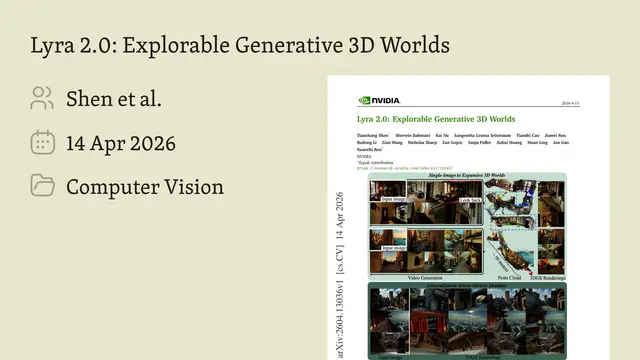
Take any video on your phone and watch it again from a completely different camera angle. Vista4D makes this possible by building a 4D point cloud that captures both the geometry and motion of your scene, then uses that structure to guide a video diffusion model in resynthesizing the footage from any viewpoint you choose.
The key innovation is temporal persistence. While previous methods build a separate 3D point cloud for every single frame, Vista4D identifies static pixels through segmentation and aggregates them into one world-space structure that spans the entire video. This explicit geometric memory is concatenated with the source video latents, giving the diffusion transformer both implicit and explicit context to preserve content and follow the new camera trajectory precisely.
Training with real depth artifacts rather than idealized geometry proves critical. When Vista4D encounters the noisy point clouds that come from actual monocular depth estimators, it corrects streaking and temporal jitter by leaning on the in-context source video. Baseline methods trained only on clean data fail completely under these real-world conditions.
The numbers tell a clear story. Vista4D achieves the lowest camera control error, the best 3D consistency measured by reprojection, and wins user preference in over 67% of comparisons for source content preservation and 77% for overall fidelity. This isn't a marginal improvement; it's a statistically significant leap over every baseline.
This 4D grounding paradigm unlocks real post-production power. You can expand scenes by fusing casual captures from multiple angles into the point cloud, recompose dynamic elements by directly editing their geometry, and handle long videos through chunk-wise inference with a cumulative 4D memory that preserves spatial coherence across minutes of footage.
Vista4D transforms every video into a manipulable 4D asset, where the camera is no longer fixed at capture time but becomes a creative choice in post. To dive deeper into how 4D point clouds are reshaping video synthesis and to create your own research explainers, visit EmergentMind.com.