FedTGP: Adaptive Prototypes for Heterogeneous Federated Learning
This presentation explores FedTGP, a breakthrough approach to federated learning that addresses the dual challenges of data and model heterogeneity. By introducing trainable global prototypes with adaptive-margin-enhanced contrastive learning, FedTGP achieves up to 9.08% performance improvement over existing methods while maintaining privacy and communication efficiency. The talk examines how dynamic prototype boundaries and enhanced class separability enable robust learning across diverse client architectures and data distributions.Script
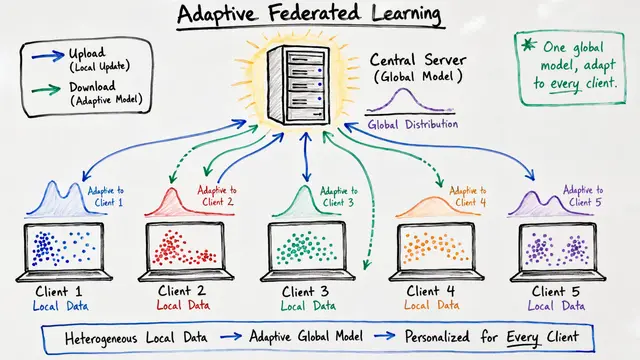
Federated learning promises privacy-preserving machine learning across distributed devices, but there's a fundamental tension: clients have wildly different data distributions and model architectures, yet they must somehow collaborate to learn shared knowledge without exposing their private parameters.
Traditional federated averaging requires identical model architectures across all clients, which severely limits real-world deployment. The authors tackle heterogeneous federated learning, where each client can use a completely different model while still contributing to global knowledge through class prototypes.
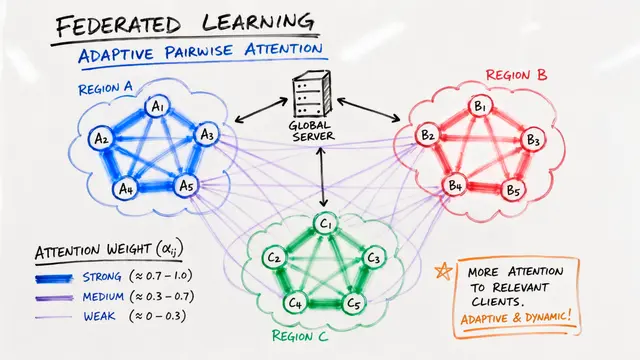
Here's where FedTGP innovates: instead of naively averaging client prototypes, the server trains a neural network to generate global prototypes with adaptive margins. This network learns to push class boundaries apart dynamically, ensuring prototypes remain semantically aligned while achieving optimal separability throughout training.
The results are striking. FedTGP outperforms established methods like FedProto and FedGen by up to 9.08 percent across multiple datasets, all while maintaining the communication efficiency and privacy guarantees that make prototype-based federated learning practical.
T-SNE visualizations reveal the mechanism at work. While FedProto produces overlapping class representations with fuzzy boundaries, FedTGP achieves crisp inter-class discrimination, both at the server and across heterogeneous client test distributions, proving that adaptive margins genuinely enhance prototype learning.
FedTGP transforms how we think about collaborative learning in privacy-sensitive environments, proving that model diversity and data heterogeneity aren't obstacles to overcome but dimensions to embrace. To dive deeper into adaptive prototype learning and create your own explanatory videos, visit EmergentMind.com.