- The paper presents GRL as a novel approach that integrates GNN and RL to optimize control strategies for both transmission and distribution grids.
- It details methodologies such as multi-agent setups and hierarchical RL to manage the vast action space and maintain grid stability.
- The survey demonstrates practical applications in energy markets and EV charging, highlighting improvements in system efficiency and reliability.
Graph Reinforcement Learning for Power Grids: A Comprehensive Survey
Graph reinforcement learning (GRL) is emerging as a powerful methodology for managing the complexities inherent in modern power grid systems. By integrating Graph Neural Networks (GNNs) with reinforcement learning (RL) techniques, researchers aim to leverage the topological structure of power grids to improve decision-making and control strategies across various grid implementations. This survey focuses on recent advancements and applications of GRL within the domain of transmission and distribution grids, as well as related energy sectors including the energy market and electric vehicle (EV) charging networks.
Fundamentals of Power Grids
Power grids are critical infrastructures composed of transmission and distribution networks (Figure 1). Transmission grids operate at high voltage levels to transport electricity over long distances, while distribution grids cater to local demand by delivering power at reduced voltages. The shift toward decentralized renewable energy sources, such as photovoltaic systems, along with the electrification of the transportation sector, introduces challenges that conventional control methods struggle to address.
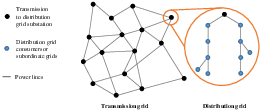
Figure 1: Visualization of the power grid structure with transmission and distribution level.
Graph Neural Networks in Power Grid Control
GNNs provide the computational framework necessary for handling graph-structured data like power grids. These networks employ message passing schemes to update node embeddings by aggregating information from neighboring nodes (Figure 2). This capability makes GNNs particularly adept at modeling the complexity and connectivity of power grid systems, allowing them to predict system behaviors and optimize control actions.
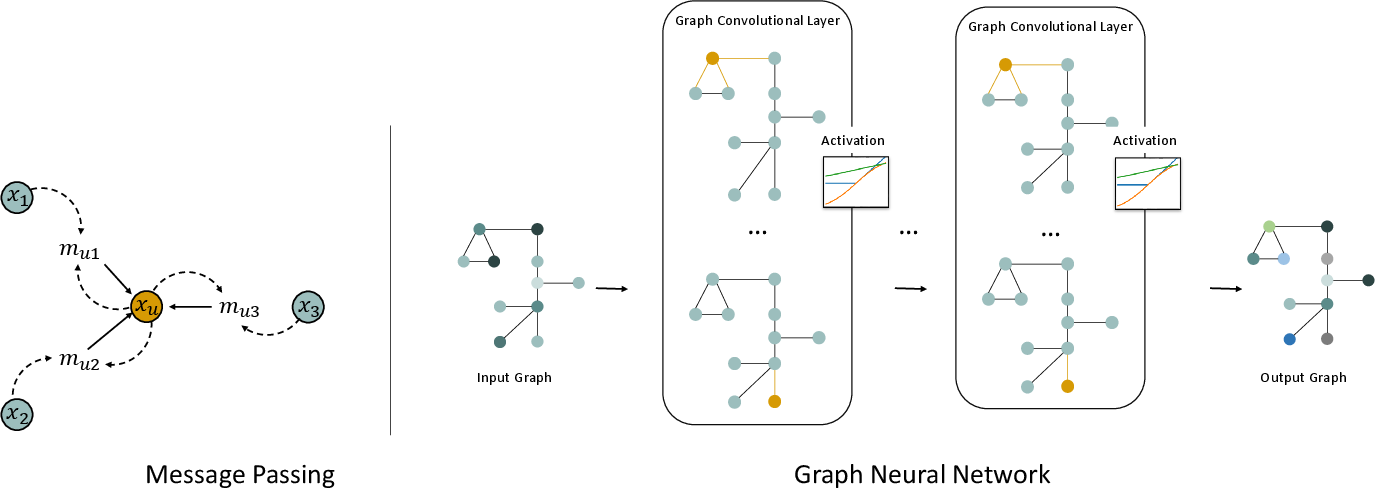
Figure 2: Left: Visualization of the general message passing scheme in GNNs.
GRL in Transmission Grids
In transmission grids, GRL methods focus on maintaining stability through actions like redispatching power and adjusting grid topology to avoid congestion. The inherent challenge is the vast action space available in these networks. Techniques involving multi-agent setups, hierarchical RL, and topological action recommendations have shown promise in reducing operational complexities while enhancing system stability. Implementations like the Grid2Op environment facilitate simulation-based training, allowing researchers to refine these approaches in controlled settings.
GRL in Distribution Grids
Voltage regulation in distribution grids is a critical task exacerbated by the rise of distributed generation sources. GRL approaches offer adaptive solutions for managing voltages and minimizing network losses by leveraging reactive power control through distributed resources, such as smart inverters and energy storage systems. Emergency situations necessitate rapid responses like load shedding, where GRL methodologies have been employed to predict and automate corrective actions efficiently.
Applications in Energy Markets and EV Charging
Beyond grid operations, GRL is applied in optimizing the energy market and managing EV charging infrastructures. In markets, GRL facilitates decentralized trading strategies, improving bidding efficiency and profitability through enhanced prediction capabilities. For EV charging, GRL contributes to efficient station management by dynamically allocating resources and optimizing routing paths, supporting the seamless integration of electric vehicles into existing power networks.
Conclusion
The application of GRL in power grids demonstrates a promising frontier in advancing control strategies tailored for increasingly complex electricity networks. The ability to incorporate the graph structure of grids into RL algorithms offers a refined approach to decision-making that traditional methods cannot match. As the integration of renewable energy and electric vehicles continues to challenge power systems, GRL is positioned as a pivotal technology that can significantly enhance the responsiveness, reliability, and efficiency of future energy infrastructures. Future research should focus on improving scalability, robustness to real-world noise, and the development of deeper neural architectures to fully exploit the potential of GRL in addressing the evolving demands of modern power systems.