- The paper introduces IDM–VTON, a novel diffusion model architecture that leverages dual attention modules to maintain high garment fidelity.
- It integrates TryonNet, IP-Adapter, and GarmentNet, achieving superior LPIPS, SSIM, and FID scores compared to previous methods.
- The study demonstrates robust performance in complex poses and backgrounds, offering promising applications in online retail and virtual reality.
Enhancements in Diffusion Models for Virtual Try-On
Introduction
The paper "Improving Diffusion Models for Authentic Virtual Try-On in the Wild" explores an innovative approach to virtual try-on applications using diffusion models. It addresses a significant challenge in e-commerce and fashion technology: generating realistic images of a person wearing a given garment from just two images—one of the person and another of the garment. Despite advances in generative models, existing techniques often compromise garment identity or image authenticity, issues that this research aims to mitigate through a novel model architecture called IDM--VTON.
Methodology
The IDM--VTON model leverages a unique architecture that improves upon traditional diffusion models by incorporating dual attention modules designed to enhance garment fidelity and realism in try-on images. This model inputs images of a person and a garment and processes these through distinct pathways to maintain high fidelity of garment features while ensuring the natural appearance of try-on images.
The core architecture consists of three main components:
- TryonNet: A base UNet responsible for processing the person image, enhanced with additional inputs like a segmentation mask and pose information.
- IP-Adapter: An image prompt adapter that encodes high-level semantic information from the garment image using a pretrained CLIP model, contributing to maintaining garment identity.
- GarmentNet: A specialized UNet focusing on capturing fine-grained details, such as textures and patterns, of the garment image, which are integrated into the TryonNet's processing pipeline through a self-attention mechanism.
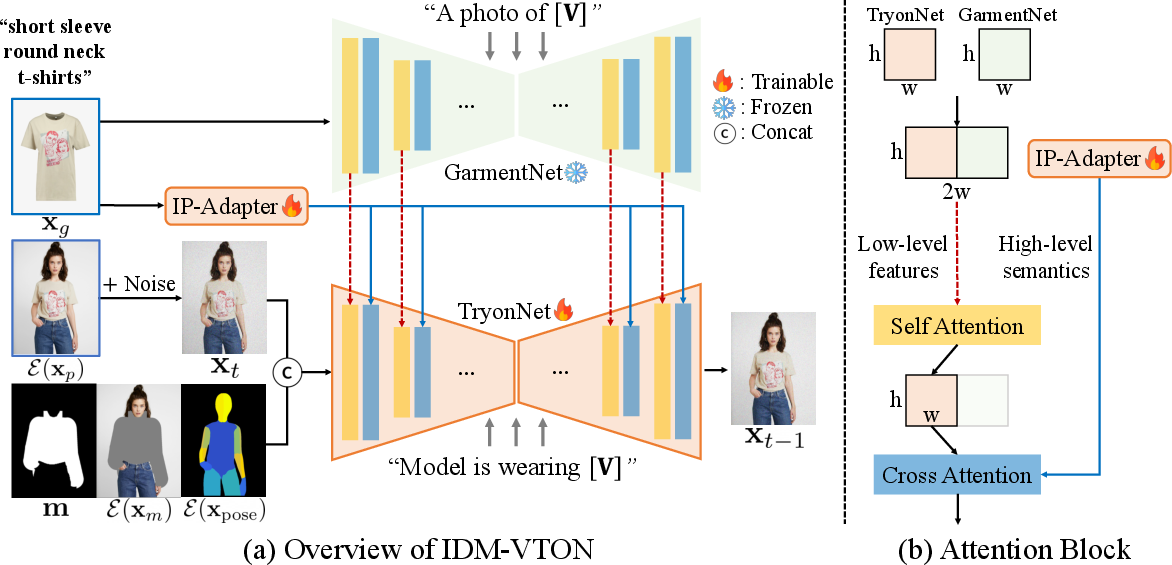
Figure 1: Overview of IDM--VTON, highlighting the architecture with key components like TryonNet, IP-Adapter, and GarmentNet.
Qualitative and Quantitative Evaluation
The research presented comprehensive qualitative and quantitative evaluations across several datasets. It demonstrated superior performance over prior methods in maintaining garment detail and creating realistic composite images. Notably, IDM--VTON excelled in scenarios involving diverse poses and intricate backgrounds, as evidenced by robust results on the challenging In-the-Wild dataset.
Quantitative metrics highlighted include:
- LPIPS and SSIM: For assessing perceptual similarity and structural fidelity, IDM--VTON significantly outperformed GAN-based and previous diffusion-based methods.
- FID Scores: Indicating high fidelity and realism of the generated images, IDM--VTON reported lower FID scores demonstrating superior quality.
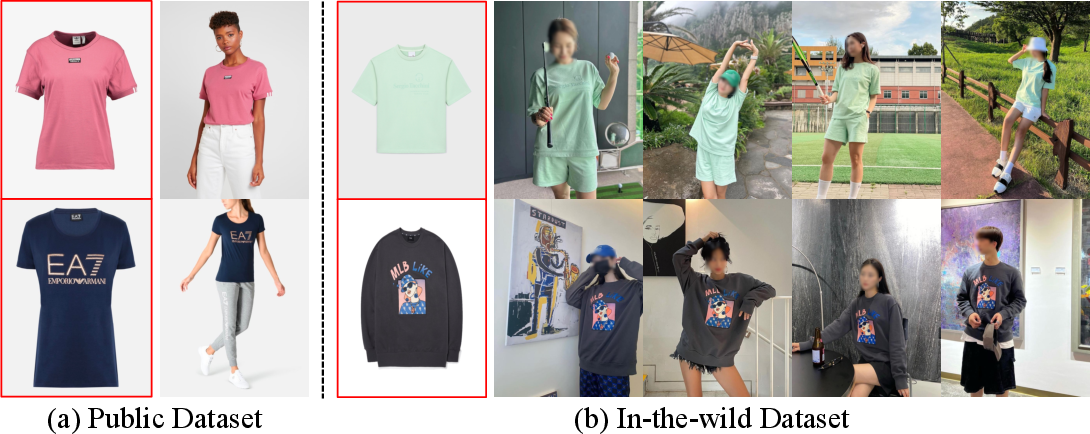
Figure 2: Comparisons between datasets used, notably emphasizing the In-the-Wild dataset's complexity.
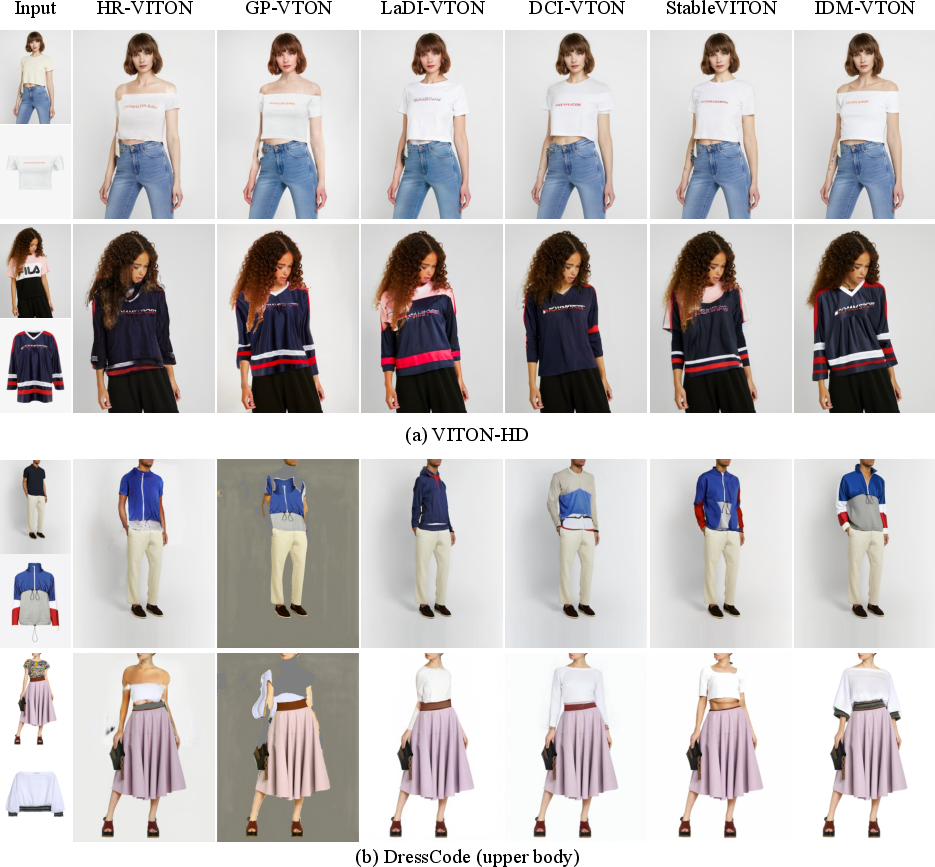
Figure 3: Qualitative results on VITON-HD and DressCode dataset show the enhanced detail and consistency IDM--VTON maintains.
Customization and Adaptation
The study also explored customization techniques to enhance model adaptability to unseen scenarios, employing fine-tuning strategies with high efficacy. This approach allowed IDM--VTON to dynamically adjust to specific garment-person image configurations, ensuring image fidelity in varied contexts.
Implications and Future Work
The paper significantly contributes to the field by demonstrating that detailed garment information and adaptive architectures in diffusion models can produce higher-quality virtual try-on results than existing methods. The methodology has applications beyond fashion, including virtual reality and online retail, where personalized and accurate visual representations are crucial.
The exploration of detailed textual descriptions for garments, alongside image data, hints at future integrations of multimodal data sources for improved model performance. The potential integration of real-time try-on capabilities and further refinement in image realism through neural training could herald transformative changes in digital retail experiences.
Conclusion
In conclusion, the IDM--VTON model marks a pivotal advancement in virtual try-on technology through its architectural innovations in diffusion models, demonstrating enhanced capabilities in creating authentic images that maintain garment identity and wearer realism. This study lays groundwork for future research into adaptive generative models and their application across technology and commerce sectors.