- The paper introduces DECOR, a deep neural network that completes room impulse responses by predicting exponential decay envelopes from early reflections.
- The methodology employs an autoencoder to extract features from the first 50 ms of the RIR, enabling efficient modeling of late reverberation.
- The study demonstrates that DECOR achieves comparable performance to the FiNS baseline with a significantly reduced computational footprint.
Deep Room Impulse Response Completion
Introduction
The research paper, titled "Deep Room Impulse Response Completion," introduces a novel approach to rendering room impulse responses (RIRs) critical for applications in virtual reality (VR) and video games. Traditional methods of generating RIRs, either through measurement or simulation, face challenges related to computational cost and signal-to-noise ratio. This paper addresses these challenges by proposing "RIR completion," a task aimed at efficiently synthesizing the late reverberation of an RIR given only the early reflections. The proposed method, "DECOR" (Deep Exponential Completion of Room impulse responses), utilizes a deep neural network with an autoencoder architecture to predict exponential decay envelopes, which are then employed to shape filtered noise sequences.
Methodology
DECOR Architecture: The architecture of DECOR is built around the autoencoder paradigm. The encoder processes the first 50 ms of the RIR, extracting latent features from the early reflections. The decoder leverages these features to predict the remaining RIR tail by shaping exponential decay envelopes. This approach efficiently models room acoustics with a reduced computational footprint compared to traditional simulation methods.
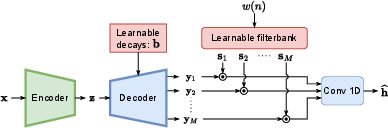
Figure 1: DECOR overview. The RIR head x is processed through an autoencoder to predict the RIR tail.
Training and Evaluation: DECOR was trained on a dataset comprising 4,000 RIRs collected from various rooms, ensuring diverse environmental parameters. The model's efficacy was tested against a modified version of the FiNS network, a state-of-the-art RIR generation method. The comparison showed that DECOR achieved comparable performance with significantly reduced model size, highlighting its computational efficiency.
Results
Performance Metrics: DECOR demonstrated robust performance across several metrics, including MSTFT error, EDF error, T60, and DRR. Though slightly underperforming the FiNS baseline in some metrics, DECOR's efficiency in terms of computational resource requirements was notable.
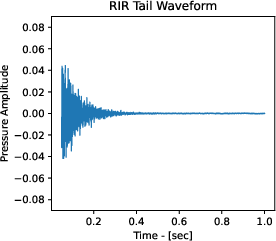
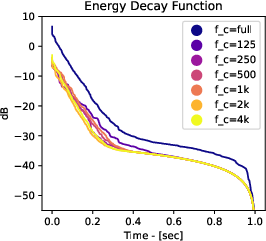
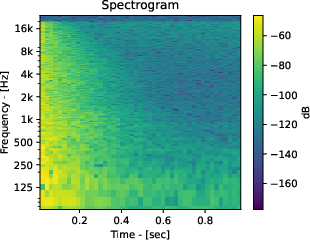
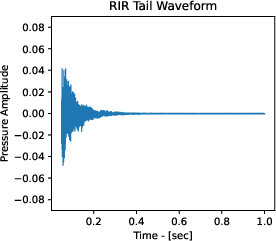
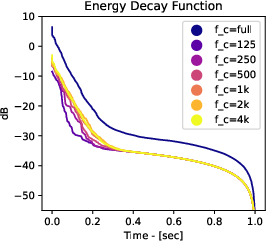
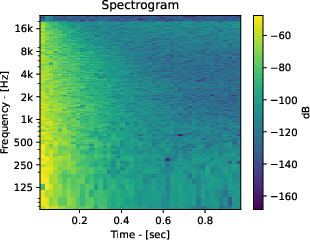
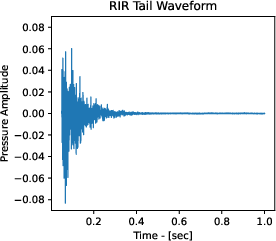
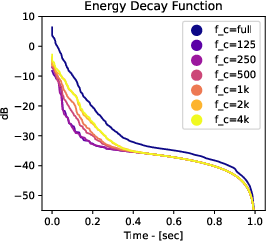
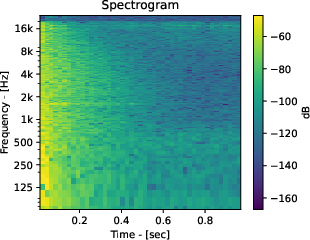
Figure 2: Model outputs on a test dataset sample. Evaluation of DECOR against the FiNS baseline.
Generalization: The generalization capability of DECOR was assessed on the BUT ReverbDB dataset, which DECOR had not encountered during training. Although a performance degradation was noted, DECOR still provided reasonable approximations, indicating potential for practical deployment with further refinement.
Discussion
The DECOR model introduces an innovative application of deep learning to the domain of acoustic modeling. Its design not only facilitates fast RIR generation suitable for real-time applications in VR and gaming but also provides insights into the role of early reflections in determining late reverberation characteristics. The model's interpretability and integration with diverse rendering techniques enhance its applicability.
While DECOR exhibits potential, improvements in model generalization and an increase in training dataset size and diversity are necessary to enhance its robustness. Moreover, the methodology's reliance on exponential decay envelopes offers a promising direction for more compact and efficient room acoustics models.
Conclusion
The DECOR model presents an effective strategy for deep room impulse response completion, representing a significant step toward efficient and real-time acoustic modeling. With further development, it could transform RIR generation, particularly in applications requiring fast computation and high accuracy. This research opens new avenues for acoustic research, particularly in leveraging deep learning for real-time interactive environments.