The Impact of Language Adapters in Cross-Lingual Transfer for NLU
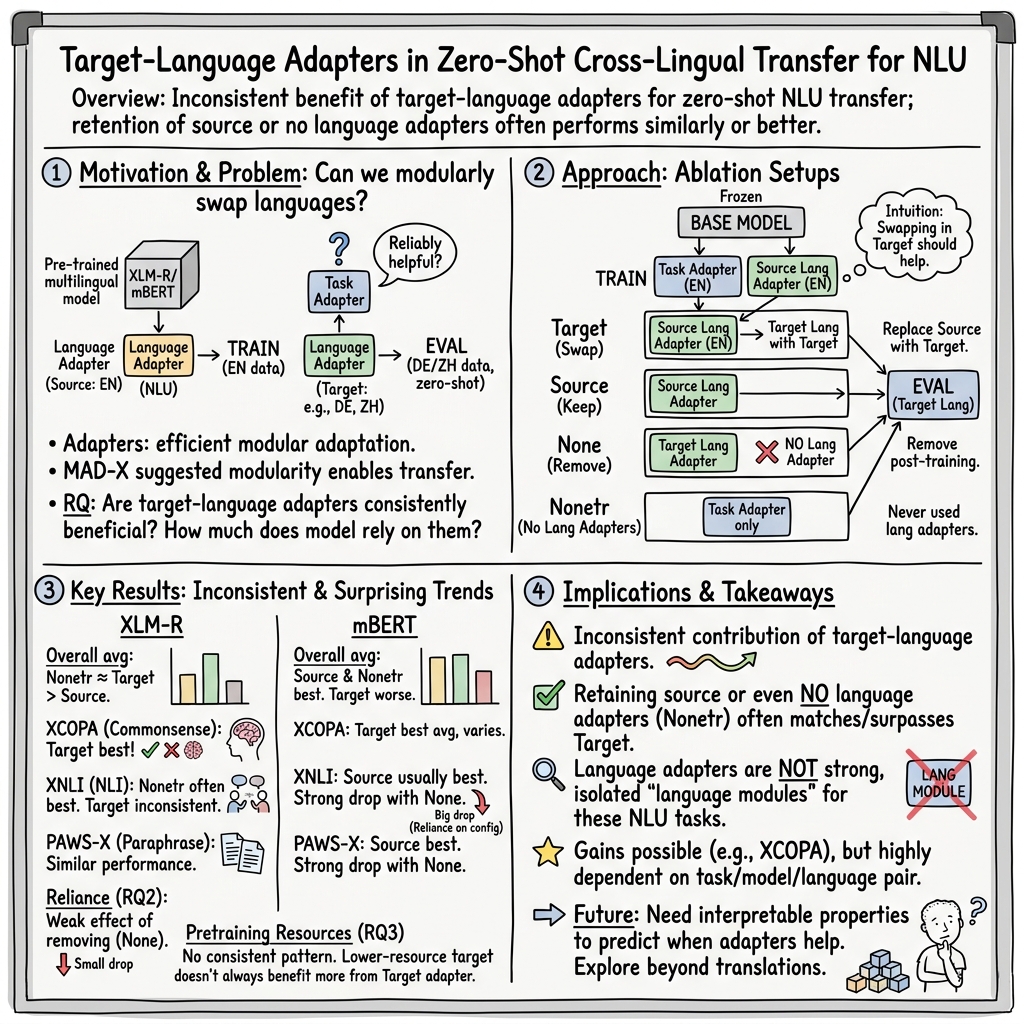
Abstract: Modular deep learning has been proposed for the efficient adaption of pre-trained models to new tasks, domains and languages. In particular, combining language adapters with task adapters has shown potential where no supervised data exists for a language. In this paper, we explore the role of language adapters in zero-shot cross-lingual transfer for natural language understanding (NLU) benchmarks. We study the effect of including a target-language adapter in detailed ablation studies with two multilingual models and three multilingual datasets. Our results show that the effect of target-language adapters is highly inconsistent across tasks, languages and models. Retaining the source-language adapter instead often leads to an equivalent, and sometimes to a better, performance. Removing the language adapter after training has only a weak negative effect, indicating that the language adapters do not have a strong impact on the predictions.
- On the cross-lingual transferability of monolingual representations. In Proceedings of the 58th Annual Meeting of the Association for Computational Linguistics, pages 4623–4637, Online. Association for Computational Linguistics.
- Analyzing the mono- and cross-lingual pretraining dynamics of multilingual language models. In Proceedings of the 2022 Conference on Empirical Methods in Natural Language Processing, pages 3575–3590, Abu Dhabi, United Arab Emirates. Association for Computational Linguistics.
- Unsupervised cross-lingual representation learning at scale. In Proceedings of the 58th Annual Meeting of the Association for Computational Linguistics, pages 8440–8451, Online. Association for Computational Linguistics.
- Alexis Conneau and Guillaume Lample. 2019. Cross-lingual language model pretraining. In Advances in Neural Information Processing Systems, volume 32. Curran Associates, Inc.
- XNLI: Evaluating cross-lingual sentence representations. In Proceedings of the 2018 Conference on Empirical Methods in Natural Language Processing, pages 2475–2485, Brussels, Belgium. Association for Computational Linguistics.
- BERT: Pre-training of deep bidirectional transformers for language understanding. In Proceedings of the 2019 Conference of the North American Chapter of the Association for Computational Linguistics: Human Language Technologies, Volume 1 (Long and Short Papers), pages 4171–4186, Minneapolis, Minnesota. Association for Computational Linguistics.
- Abteen Ebrahimi and Katharina Kann. 2021. How to adapt your pretrained multilingual model to 1600 languages. In Proceedings of the 59th Annual Meeting of the Association for Computational Linguistics and the 11th International Joint Conference on Natural Language Processing (Volume 1: Long Papers), pages 4555–4567, Online. Association for Computational Linguistics.
- Fahim Faisal and Antonios Anastasopoulos. 2022. Phylogeny-inspired adaptation of multilingual models to new languages. In Proceedings of the 2nd Conference of the Asia-Pacific Chapter of the Association for Computational Linguistics and the 12th International Joint Conference on Natural Language Processing (Volume 1: Long Papers), pages 434–452, Online only. Association for Computational Linguistics.
- APE at scale and its implications on MT evaluation biases. In Proceedings of the Fourth Conference on Machine Translation (Volume 1: Research Papers), pages 34–44, Florence, Italy. Association for Computational Linguistics.
- Match the script, adapt if multilingual: Analyzing the effect of multilingual pretraining on cross-lingual transferability. In Proceedings of the 60th Annual Meeting of the Association for Computational Linguistics (Volume 1: Long Papers), pages 1500–1512, Dublin, Ireland. Association for Computational Linguistics.
- Martin Gellerstam. 1986. Translationese in Swedish novels translated from English. Translation studies in Scandinavia, 1:88–95.
- SemEval-2012 task 7: Choice of plausible alternatives: An evaluation of commonsense causal reasoning. In *SEM 2012: The First Joint Conference on Lexical and Computational Semantics – Volume 1: Proceedings of the main conference and the shared task, and Volume 2: Proceedings of the Sixth International Workshop on Semantic Evaluation (SemEval 2012), pages 394–398, Montréal, Canada. Association for Computational Linguistics.
- On the effectiveness of adapter-based tuning for pretrained language model adaptation. In Proceedings of the 59th Annual Meeting of the Association for Computational Linguistics and the 11th International Joint Conference on Natural Language Processing (Volume 1: Long Papers), pages 2208–2222, Online. Association for Computational Linguistics.
- Parameter-efficient transfer learning for NLP. In Proceedings of the 36th International Conference on Machine Learning, volume 97 of Proceedings of Machine Learning Research, pages 2790–2799. PMLR.
- Lora: Low-rank adaptation of large language models. CoRR, abs/2106.09685.
- Turning english-centric llms into polyglots: How much multilinguality is needed? arXiv preprint arXiv:2312.12683.
- Revisiting pretraining with adapters. In Proceedings of the 6th Workshop on Representation Learning for NLP (RepL4NLP-2021), pages 90–99, Online. Association for Computational Linguistics.
- From zero to hero: On the limitations of zero-shot language transfer with multilingual Transformers. In Proceedings of the 2020 Conference on Empirical Methods in Natural Language Processing (EMNLP), pages 4483–4499, Online. Association for Computational Linguistics.
- Michael McCloskey and Neal J Cohen. 1989. Catastrophic interference in connectionist networks: The sequential learning problem. In Psychology of learning and motivation, volume 24, pages 109–165. Elsevier.
- Lifting the curse of multilinguality by pre-training modular transformers. In Proceedings of the 2022 Conference of the North American Chapter of the Association for Computational Linguistics: Human Language Technologies, pages 3479–3495, Seattle, United States. Association for Computational Linguistics.
- AdapterHub: A framework for adapting transformers. In Proceedings of the 2020 Conference on Empirical Methods in Natural Language Processing: System Demonstrations, pages 46–54, Online. Association for Computational Linguistics.
- Modular deep learning. arXiv preprint arXiv:2302.11529.
- MAD-X: An Adapter-Based Framework for Multi-Task Cross-Lingual Transfer. In Proceedings of the 2020 Conference on Empirical Methods in Natural Language Processing (EMNLP), pages 7654–7673, Online. Association for Computational Linguistics.
- XCOPA: A multilingual dataset for causal commonsense reasoning. In Proceedings of the 2020 Conference on Empirical Methods in Natural Language Processing (EMNLP), pages 2362–2376, Online. Association for Computational Linguistics.
- Roger Ratcliff. 1990. Connectionist models of recognition memory: constraints imposed by learning and forgetting functions. Psychological review, 97(2):285.
- Choice of plausible alternatives: An evaluation of commonsense causal reasoning. In AAAI spring symposium: logical formalizations of commonsense reasoning, pages 90–95.
- AdapterDrop: On the efficiency of adapters in transformers. In Proceedings of the 2021 Conference on Empirical Methods in Natural Language Processing, pages 7930–7946, Online and Punta Cana, Dominican Republic. Association for Computational Linguistics.
- Social IQa: Commonsense reasoning about social interactions. In Proceedings of the 2019 Conference on Empirical Methods in Natural Language Processing and the 9th International Joint Conference on Natural Language Processing (EMNLP-IJCNLP), pages 4463–4473, Hong Kong, China. Association for Computational Linguistics.
- UnNatural Language Inference. In Proceedings of the 59th Annual Meeting of the Association for Computational Linguistics and the 11th International Joint Conference on Natural Language Processing (Volume 1: Long Papers), pages 7329–7346, Online. Association for Computational Linguistics.
- UDapter: Language adaptation for truly Universal Dependency parsing. In Proceedings of the 2020 Conference on Empirical Methods in Natural Language Processing (EMNLP), pages 2302–2315, Online. Association for Computational Linguistics.
- Superglue: A stickier benchmark for general-purpose language understanding systems. In Advances in Neural Information Processing Systems, volume 32. Curran Associates, Inc.
- A broad-coverage challenge corpus for sentence understanding through inference. In Proceedings of the 2018 Conference of the North American Chapter of the Association for Computational Linguistics: Human Language Technologies, Volume 1 (Long Papers), pages 1112–1122, New Orleans, Louisiana. Association for Computational Linguistics.
- PAWS-X: A cross-lingual adversarial dataset for paraphrase identification. In Proceedings of the 2019 Conference on Empirical Methods in Natural Language Processing and the 9th International Joint Conference on Natural Language Processing (EMNLP-IJCNLP), pages 3687–3692, Hong Kong, China. Association for Computational Linguistics.
- Bloom+ 1: Adding language support to bloom for zero-shot prompting. arXiv preprint arXiv:2212.09535.
- PAWS: Paraphrase adversaries from word scrambling. In Proceedings of the 2019 Conference of the North American Chapter of the Association for Computational Linguistics: Human Language Technologies, Volume 1 (Long and Short Papers), pages 1298–1308, Minneapolis, Minnesota. Association for Computational Linguistics.
Paper Prompts
Sign up for free to create and run prompts on this paper.
Top Community Prompts
Explain it Like I'm 14
What this paper is about
This paper studies a simple question: If you add “language adapters” (small plug-in modules) to big multilingual LLMs, do they actually help the model understand new languages when there’s no training data for those languages?
Key ideas and questions
The authors asked three main questions:
- How often do target-language adapters help? They tested whether swapping in a target-language adapter (for example, a Spanish adapter when testing in Spanish) improves results compared to keeping the source-language adapter (like English) or using no language adapter.
- Do models really rely on language adapters? They checked what happens if you remove the language adapter entirely after training.
- Does the amount of data a language had during pre-training matter? They explored whether adapters help more when the target language has less data in the base model’s pre-training.
How they tested it (in everyday terms)
Think of a big multilingual model as a powerful camera that’s already good at taking pictures (understanding many languages). Adapters are like small, snap-on lenses you can add:
- Language adapters: lenses that help with a specific language (e.g., Spanish).
- Task adapters: lenses that help with a specific task (e.g., detecting if two sentences say the same thing).
The researchers used two popular multilingual models—XLM-R and mBERT—and three language understanding tasks:
- PAWS-X: Decide if two sentences mean the same thing (paraphrase detection).
- XNLI: Decide if one sentence supports, contradicts, or is unrelated to another (natural language inference).
- XCOPA: Choose the most likely cause or result of a situation (commonsense causal reasoning).
They trained models with task adapters and experimented with language adapters in four setups:
- Target: Train with a source language (often English), then switch to the target-language adapter at test time.
- Source: Keep the source-language adapter even when testing in the target language.
- None: Train with a source-language adapter but remove the language adapter at test time.
- Nonetr: Never use language adapters at all—only use task adapters.
This “ablation” style (systematically turning parts on/off) helps reveal what each adapter actually contributes.
What they found (and why it matters)
Here are the big takeaways, explained simply:
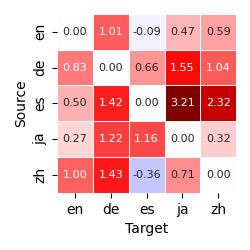
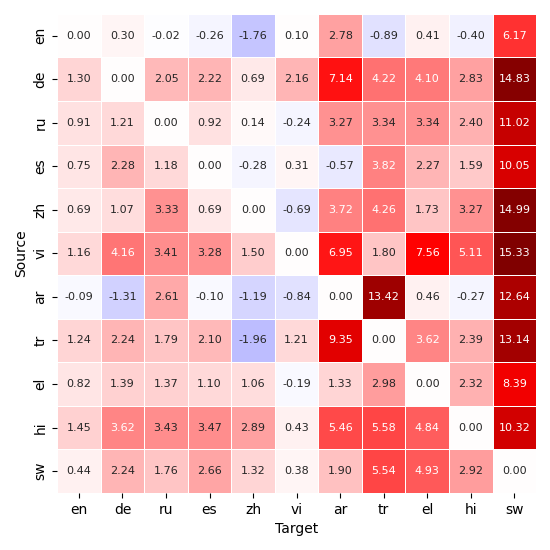
- Adapters aren’t consistently helpful. Swapping in the target-language adapter did not reliably improve performance. Sometimes keeping the source-language adapter (like English) was just as good—or better.
- Often, no language adapter worked best. In many cases, the “Nonetr” setup (no language adapters at all) performed as well as or better than the setups that used language adapters. This suggests the base models’ multilingual skills plus the task adapter carry much of the load.
- Model differences matter:
- XLM-R: Slight average gains from using target-language adapters, especially on XCOPA (the commonsense task).
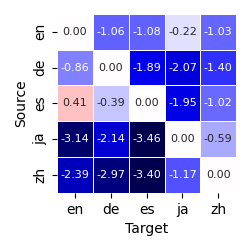
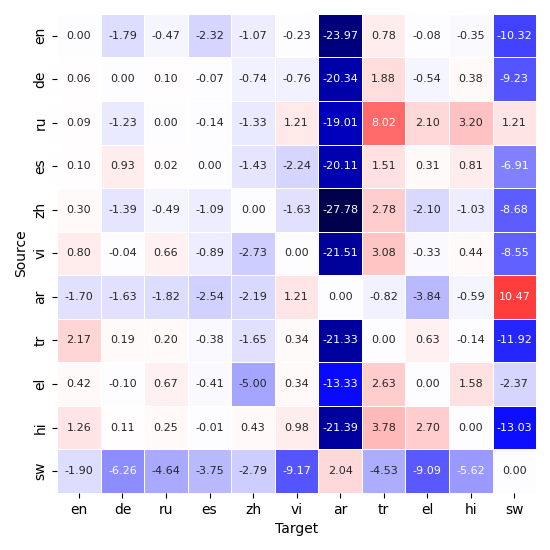
- mBERT: Often did worse with target-language adapters; it was also more sensitive if you removed adapters after training.
- Task differences matter:
- XCOPA (harder, requiring more nuanced understanding): Target-language adapters helped more, especially with XLM-R.
- PAWS-X and XNLI (more structured and often close translations): Using target-language adapters gave mixed or small benefits.
- Low-resource languages sometimes benefit—but not consistently. There were hints that lower-resource languages (those with less pre-training data) gained more from target-language adapters in one model-task combo (XLM-R on XNLI). But this pattern didn’t hold across everything. Swahili was a strong positive outlier in some cases.
- Removing the language adapter after training didn’t hurt much (especially in XLM-R). This means the model’s predictions didn’t rely heavily on language adapters, which weakens the idea that language adapters act as a strong, separate “language module.”
Why this is important: If language adapters don’t reliably help, teams can save time and compute by not using them—or by testing them selectively—especially when the base model is already multilingual and a task adapter is used.
What this means going forward
- Don’t assume language adapters will help: Try them, but expect mixed results. Sometimes the best choice is to keep the source-language adapter or skip language adapters entirely.
- Harder, more “language-heavy” tasks may benefit more: For tasks like causal commonsense (XCOPA), target-language adapters helped more than for simpler or more structured tasks.
- Focus on when and why adapters help: The authors recommend more work to identify the conditions—like specific tasks, base models, or language properties—where language adapters reliably boost performance.
- Practical tip: If you’re adapting to a new language with little or no labeled data, test multiple adapter setups (Target, Source, None, Nonetr) rather than assuming one will be best.
In one sentence
Language adapters can help sometimes, especially on harder tasks or some low-resource languages, but their benefits are inconsistent—often the base multilingual model plus a task adapter does just as well, so adapters should be used selectively and tested case by case.
Knowledge Gaps
Knowledge gaps, limitations, and open questions
Below is a single, focused list of what remains missing, uncertain, or unexplored in the paper, framed to be concrete and actionable for future research.
- Predictive factors: No clear, interpretable predictors were identified for when target-language adapters help (e.g., properties of base model, task type, language pair, script similarity, morphological complexity, typological distance); systematically deriving such predictors remains open.
- Model scale and family: Only encoder-base models (XLM-R-base, mBERT) were tested; it is unknown whether results hold for larger encoders, encoder–decoders (e.g., mT5), or LLM-scale models where prior work suggests different behavior.
- Adapter design breadth: Only Pfeiffer-style adapters were used; impacts of alternative PEFT methods (e.g., LoRA, Prefix/Prompt/IA³/Compacter), parallel/serial adapter placements, layer-wise variation, or invertible adapters (as in MAD-X) are untested.
- Single-language adapter only: Combining multiple language adapters (e.g., source+target stacking, AdapterFusion, gated mixture-of-language-experts) was not explored; potential gains from composition remain unknown.
- Frozen language adapters: Language adapters were frozen during task training; it is unclear whether jointly fine-tuning (lightly or fully) language+task adapters improves stability or effectiveness, especially for difficult transfers.
- Capacity and placement: No ablation on adapter bottleneck size, number of layers used, or layer-specific placements; sensitivity to adapter capacity and depth remains unquantified.
- Baseline breadth: No comparison to full model fine-tuning, continued pretraining on target language, or prompt-based tuning; the relative merit of language adapters vs. these baselines in zero-/few-shot settings is unresolved.
- Task coverage: Only sentence-level NLU classification was studied (PAWS-X, XNLI, XCOPA); generalization to sequence labeling (NER), parsing, QA, retrieval, and open-ended generation is unknown.
- Few-shot and semi-supervised regimes: The role of language adapters when limited target-language supervision is available (few-shot or weakly supervised) was not tested.
- Unseen/very-low-resource languages: Evaluation of languages absent from base-model pretraining was minimal (e.g., ht, qu only, and only on XCOPA); broader coverage across scripts and families is needed.
- Tokenization effects: The influence of subword vocabulary coverage and source–target subword overlap on adapter utility was not analyzed; quantifying and controlling for tokenizer mismatch is an open need.
- Language similarity signals: No explicit correlation analysis between adapter gains and linguistic distance (family, typology, script, word-order); testing structured predictors could clarify when adapters help.
- Directionality and asymmetry: Mixed findings for high→low vs. low→high transfer were not resolved; a controlled grid over resource levels and balanced domains is needed to isolate directionality effects.
- Translation artifacts: All datasets are human translations from English; the degree to which translationese and literalness inflate/depress cross-lingual transfer and adapter gains remains unmeasured.
- Native datasets: Lack of native (non-translated) target-language benchmarks limits external validity; testing on original corpora would clarify real-world utility.
- XCOPA specificity: Hypotheses that XCOPA benefits more due to difficulty or less literal translations were not validated; measuring translation closeness and conducting error analyses on phenomena (cause/effect, commonsense) is pending.
- Adapter pretraining homogeneity: AdapterHub language adapters likely vary in training data quality and recipe by language; re-training under a controlled, uniform protocol is needed to disentangle true effects from adapter-quality variance.
- mBERT pretraining proxy: The paper approximates mBERT resource sizes via current Wikipedia article counts, which may misrepresent original pretraining; accurate reconstruction or controlled pretraining is needed to validate RQ3 analyses.
- Statistical rigor: Differences are often small (≤2–3pp), yet no significance tests or confidence intervals are reported; rigorous statistical validation is needed to separate signal from noise across many comparisons.
- Variance and robustness: Only five seeds were used; broader seed sweeps, learning curves, and robustness checks (e.g., adversarial perturbations, domain shifts) could reveal stability of the observed effects.
- Mechanistic understanding: Claims that language adapters have limited impact are based on behavioral results; probing (e.g., diagnostic classifiers), representational similarity (CKA), and attribution analyses could reveal how/where adapters (don’t) alter representations.
- Training-time role vs. inference-time reliance: Since removing adapters after training often hurts little, it is unclear whether adapters act mainly as training-time regularizers or scaffolds; controlled drop-path/drop-adapter studies during training are needed.
- Efficiency trade-offs: Inference and memory overheads of language adapters vs. other PEFT methods were not measured; cost–effectiveness analyses are needed for deployment guidance.
- Multi-source task training: The study trains task adapters per single source language; joint multi-source training (or curriculum over sources) may change reliance on language adapters and should be evaluated.
- Code-switching and mixed scripts: Adapter behavior under code-switching or mixed-script inputs was not assessed; this is relevant for multilingual applications.
- Calibration and uncertainty: The effect of language adapters on probability calibration, confidence, and error consistency across languages remains unknown.
- Catastrophic interference across tasks: The benefits of language modularity for lifelong/multi-task learning (sequences of tasks/languages) were not evaluated; do language adapters prevent interference in NLU at scale?
- Domain mismatch: Language adapters trained on Wikipedia may not match benchmark domains; experiments varying domain alignment are needed to test domain-sensitivity of adapter gains.
- Data size sensitivity: The impact of task training set size (subsampling curves) on the relative value of language adapters remains unexplored.
- Outlier analysis: Strong anomalies (e.g., mBERT Arabic/Swahili behavior) were observed but not diagnosed; targeted investigations (tokenization, script directionality, pretraining noise) could yield actionable insights.
- Alternative combination at inference: Ensembling predictions from Source and Target setups, or learning test-time gates over adapters, was not attempted; this could stabilize inconsistent gains.
- Pretraining-time modularity: Models that introduce language modularity during pretraining (e.g., modular transformers) were not tested; whether pretraining-time modularity yields more consistent zero-shot benefits remains an open question.
Practical Applications
Immediate Applications
Below are concrete, deployable ways to use the paper’s findings in real-world settings. Each bullet specifies sector links, potential tools/workflows, and key assumptions.
- Deploy multilingual NLU with “task-only adapters” as a default baseline
- What to do: Prefer the Nonetr setup (task adapters without language adapters) or keep the source-language adapter unless target-language adapters clearly win on your task-language pair.
- Why: The paper shows Nonetr is often competitive or best overall; retaining the source adapter frequently matches or beats swapping to the target adapter, especially outside commonsense reasoning (XCOPA).
- Sectors: Software, customer support, e-commerce search/ranking, content moderation, finance compliance screening, HR resume triage.
- Tools/workflows:
- Multilingual NLU deployment playbook that runs three baselines (Nonetr, Source, Target) with 5-seed evaluation on your dev set and auto-selects the winner per language.
- CI/CD step that re-validates adapter choice when tasks or model versions change.
- Assumptions/dependencies: Task distributions resemble PAWS-X/XNLI-style classification; good multilingual base model (e.g., XLM-R, mBERT) is available; target-language data is translated or close to English in structure.
- Reduce model footprint and cost by pruning language adapters when they don’t help
- What to do: Remove language adapters post-training if A/B tests show negligible impact (especially for XLM-R), to save memory and latency.
- Why: Removing the language adapter had only a weak negative effect in many cases; AdapterDrop-like pruning is often feasible without loss.
- Sectors: Edge/mobile NLP (on-device assistants, keyboards), robotics (voice commands), IoT, call-center analytics with scale constraints.
- Tools/workflows:
- Adapter inventory auditor that flags per-language adapters with <0.5–1.0 pp gain and suggests removal.
- Latency/CO2 calculator to quantify wins from pruning.
- Assumptions/dependencies: Your base model retains enough multilingual competence; inference constraints (RAM/latency) drive value; regression guardrails are in place.
- Target adapters selectively for “harder” semantic tasks (e.g., commonsense reasoning)
- What to do: Keep or add target-language adapters for tasks like XCOPA-like commonsense reasoning where the paper finds more benefit, especially on XLM-R.
- Sectors: Education (automated scoring with commonsense), healthcare triage dialogue systems, legal reasoning support, safety incident reporting analytics.
- Tools/workflows:
- Task complexity classifier (heuristic: low resource + causal/commonsense tasks → test target adapters).
- “Adapter-on-demand” toggles in production that enable target adapters only on task segments known to benefit.
- Assumptions/dependencies: Task truly requires nuanced target-language semantics; existing target adapters (AdapterHub) are available or trainable; consistent evaluation data exists.
- Make base-model choice a first-order decision in multilingual rollout
- What to do: Prefer XLM-R for robustness to adapter changes; be cautious with mBERT where dropping or swapping adapters can hurt.
- Why: mBERT is more sensitive to adapter configurations; XLM-R often tolerates None/Source with minimal loss.
- Sectors: Platform ML teams standardizing foundation models across products.
- Tools/workflows:
- Model-selection rubric: pair tasks/languages with XLM-R vs mBERT based on sensitivity profiles and your latency/size constraints.
- Assumptions/dependencies: Your infra can host XLM-R where needed; legal/licensing OK.
- Evidence-based procurement and governance for public-sector multilingual NLP
- What to do: Require vendors to provide per-language A/B results for Target vs Source vs Nonetr; do not assume per-language adapters are necessary.
- Why: Paper shows inconsistent benefits; policy can avoid overpaying for bespoke per-language adaptation that yields no gains.
- Sectors: Government digital services, NGOs, international organizations.
- Tools/workflows:
- Procurement checklist mandating per-LLM comparisons and carbon/latency reporting with and without language adapters.
- Assumptions/dependencies: Availability of small evaluation sets per target language; audit capacity.
- Data and budget prioritization for low-resource language coverage
- What to do: Pilot target-language adapters specifically for low-resource targets where they sometimes help (e.g., XLM-R on XNLI showed bigger gains for Swahili), then decide investment.
- Why: Benefits are not uniform; strategic pilots prevent misallocation of scarce annotation or compute budgets.
- Sectors: Localization, media, social platforms, public information portals.
- Tools/workflows:
- “Coverage planner” that ranks languages by expected adapter benefit, existing pretraining resources, and business impact.
- Assumptions/dependencies: Access to AdapterHub adapters or capacity to train them; small validation sets to estimate gains.
- MLOps simplification: fewer moving parts across languages
- What to do: Standardize on task adapters and a single source adapter where viable to reduce artifact sprawl and misconfiguration risk.
- Why: The paper finds Source/Nonetr are often as good; fewer artifacts simplify versioning and incident response.
- Sectors: Any org operating multilingual ML in production.
- Tools/workflows:
- “Adapter registry” with lifecycle rules; automated drift alerts when adapter swaps degrade performance.
- Assumptions/dependencies: Clear SLOs; robust monitoring to catch language-specific regressions.
Long-Term Applications
These require further research, scaling, or development, but are directly motivated by the paper’s findings and gaps.
- Adapter selection predictors and diagnostics (meta-learning for “when do target adapters help?”)
- What to build: A predictor that uses task type, typology, script, pretraining-resource signals, and base-model features to forecast benefit of target adapters for a given language-task pair.
- Why: The paper calls for identifying interpretable conditions; current effects are inconsistent and hard to anticipate.
- Sectors: ML platforms, consultancy, academia.
- Assumptions/dependencies: Access to broad cross-task, cross-language evaluation logs; standardized metadata; reproducible training/eval.
- Runtime adapter routing and dynamic sparsity
- What to build: A gating mechanism that chooses Source, Target, or None per request, or prunes adapters dynamically (AdapterDrop) based on confidence/latency constraints.
- Why: Gains are context-dependent; dynamic routing can capture occasional benefits without paying universal costs.
- Sectors: High-throughput inference services, edge AI, finance and safety-critical monitoring where latency budgets vary.
- Assumptions/dependencies: Calibrated confidence estimators; safe fallback paths; robust online A/B infra.
- Pretraining-time modularity for language specialization
- What to build: Modular transformers with language modularity introduced at pretraining (e.g., Pfeiffer et al., 2022), enabling clearer, more potent language modules than post-hoc adapters.
- Why: The paper suggests post-hoc language adapters may contribute little on many NLU tasks; pretraining-time modularity may yield stronger, interpretable gains.
- Sectors: Foundation model providers, cloud ML platforms.
- Assumptions/dependencies: Significant compute; multilingual corpora; eval suites beyond translation artifacts.
- Hierarchical/phylogenetic adapter sharing for very low-resource languages
- What to build: Language family–aware adapter stacks that share parameters across related languages to bootstrap new ones (extending Faisal & Anastasopoulos, 2022).
- Why: The study sees occasional gains for low-resource targets; structured sharing may make these gains more consistent.
- Sectors: Government language access, humanitarian tech, education in under-served languages.
- Assumptions/dependencies: Curated linguistic relationships; tokenization and script alignment; small seed corpora.
- Non-translated, native NLU benchmarks across many languages
- What to build: New evaluation datasets not derived from English (to reduce translation artifacts) for tasks ranging from NLI to commonsense and safety.
- Why: The paper flags translation artifacts and dataset effects as potential confounders; better datasets will clarify when adapters help.
- Sectors: Academia, standards bodies, public-sector funding agencies.
- Assumptions/dependencies: Funding, native-speaker annotation pipelines, cultural adaptation.
- Carbon- and cost-aware adapter management
- What to build: Tooling that quantifies the energy and cost impacts of keeping vs pruning per-language adapters; integrates into MLOps budgeting.
- Why: The study shows many adapters add little value; removing them reduces inference and storage costs and emissions.
- Sectors: Sustainability offices, cloud FinOps, large-scale ML operators.
- Assumptions/dependencies: Accurate telemetry (GPU-hours, memory, power); harmonized cost accounting.
- Standards and policy guidance for multilingual AI procurement
- What to build: International guidelines recommending per-language A/B evidence (Target vs Source vs Nonetr), transparency on adapter choices, and reporting of performance variances.
- Why: The paper demonstrates that “more adaptation” is not always better; policy can improve ROI and fairness.
- Sectors: Governments, NGOs, multilaterals.
- Assumptions/dependencies: Stakeholder consensus, usability for non-technical evaluators, alignment with AI risk frameworks.
- Unified “Adapter Selector” product for practitioners
- What to build: An open-source/enterprise tool atop AdapterHub that:
- Automates training/eval of Task, Source, Target, None configurations.
- Reports per-language gains, costs, and recommended deployment profiles.
- Supports XLM-R, mBERT, and newer LLMs with LoRA.
- Why: The paper’s ablation protocol can be operationalized to de-risk deployments.
- Sectors: ML engineering teams, consultancies, platform vendors.
- Assumptions/dependencies: Maintenance across model versions; reproducibility; extensibility to new tasks.
- Safety and fairness auditing for cross-lingual transfer
- What to build: Audits that check whether removing or retaining adapters changes error profiles or biases across languages (even when accuracy is similar).
- Why: Inconsistent adapter effects could mask disparate impacts; auditing ensures responsible deployment.
- Sectors: Regulated industries (healthcare, finance), public-sector services.
- Assumptions/dependencies: Access to demographic or dialectal test sets; organizational processes for remediation.
Glossary
- ablation study: A systematic experiment where components are removed or varied to measure their impact on performance. "detailed ablation studies"
- AdapterFusion: A technique that combines multiple adapters within a Transformer to leverage diverse knowledge. "pruning adapters from AdapterFusion models to reduce inference time."
- AdapterHub: A repository and toolkit for sharing and using pre-trained adapters for Transformer models. "We use pre-trained language adapters from AdapterHub (Pfeiffer et al., 2020a)."
- catastrophic forgetting: The degradation of previously learned knowledge when a model is fine-tuned on new tasks. "catastrophic forgetting"
- commonsense reasoning: Reasoning about everyday knowledge, causes, and effects beyond explicit text. "commonsense reasoning data sets"
- continued pre-training: Further pre-training a model on additional data (e.g., new languages/domains) after initial pre-training. "continued pre-training"
- cross-lingual transfer: Transferring knowledge learned in one language to another language. "cross-lingual transfer"
- curse of multilinguality: The phenomenon where adding many languages can dilute capacity and hurt performance. "the curse of multilinguality (Conneau et al., 2020)"
- Houlsby-style language adapters: A specific adapter architecture introduced by Houlsby et al. for parameter-efficient tuning. "Houlsby-style lan- guage adapters"
- instruction fine-tuning: Fine-tuning LLMs on instruction-following data to improve task generalization. "multilingual instruction fine-tuning of LLMs"
- invertible adapters: Adapter layers that can be inverted, allowing transformations to be reversed (e.g., for embeddings). "invertible adapters"
- language adapter: A light-weight module added to a model to specialize it for a particular language. "language adapters"
- language modularity: Designing models with explicit language-specific modules to reduce interference. "language modu- larity at pre-training time"
- LoRA: Low-Rank Adaptation, a parameter-efficient method that injects trainable low-rank matrices into pretrained weights. "LoRA (Hu et al., 2021)"
- MAD-X framework: An adapter-based framework enabling modular, multi-task cross-lingual transfer with language and task adapters. "The MAD-X framework (Pfeiffer et al., 2020b)"
- masked LLMs (MLMs): Models pre-trained to predict masked tokens in text, enabling strong language representations. "adapt MLMs to unseen languages"
- mBERT: Multilingual BERT, a Transformer model pre-trained on many languages. "multilingual BERT (mBERT)"
- modular deep learning: An approach where models are composed of interchangeable modules (e.g., adapters) for flexibility and efficiency. "Modular deep learning has been proposed"
- named entity recognition: The task of identifying and classifying entities (persons, organizations, locations) in text. "named entity recogni- tion"
- Natural Language Understanding (NLU): Tasks that require understanding the meaning and relations in text (e.g., NLI, paraphrase). "natural lan- guage understanding (NLU) benchmarks"
- parameter sharing: Sharing model parameters across languages or tasks to transfer knowledge efficiently. "parameter sharing between related languages"
- Pfeiffer adapters: An adapter configuration proposed by Pfeiffer et al., commonly used for language and task modularization. "task-specific Pfeiffer adapters"
- post-hoc fine-tuning: Fine-tuning adapters after the base model has been pre-trained, rather than integrating them during pre-training. "post-hoc fine-tuning of adapters"
- pre-training: The initial training phase on large unlabeled corpora to learn general-purpose language representations. "pre-training"
- sequential fine-tuning: Fine-tuning on multiple datasets or tasks one after another to improve performance on a target task. "sequential fine-tuning of the task adapter"
- task adapters: Lightweight modules added to specialize a model for a specific downstream task. "task adapters"
- typological features: Linguistic properties (e.g., word order, morphology) used to characterize languages for modeling. "typological features of the language"
- UDapter: A framework that integrates language adapters for dependency parsing, conditioned on typological features. "The UDapter framework (Üstün et al., 2020)"
- XLM-R (XLM-RoBERTa): A multilingual variant of RoBERTa pre-trained across many languages. "XLM-Roberta-base (XLM-R)"
- zero-shot: Evaluating or transferring to a new task or language without supervised training data for that specific setting. "zero-shot cross-lingual transfer"

