- The paper demonstrates that precise prompt design significantly improves output fidelity by reducing hallucinations and enhancing reasoning efficacy.
- It details advanced methodologies like chain-of-thought prompting, self-consistency, and graph-based reasoning to efficiently decompose complex tasks.
- Findings highlight retrieval augmentation and plugin integration as practical solutions for grounding responses and extending LLM capabilities.
Unleashing the Potential of Prompt Engineering in LLMs
Introduction
This paper, "Unleashing the potential of prompt engineering for LLMs" (2310.14735), delivers a comprehensive, methodical review of prompt engineering as both an applied science and a research domain, focused on optimizing LLM outputs. The survey systematically addresses the foundational and advanced paradigms of prompt engineering, including instruction formulation techniques, external augmentation, evaluation methodologies, and practical deployments. Emphasis is placed on prompt structure, role conditioning, advanced thought decomposition, and retrieval augmentation as critical for harnessing LLM performance. The synthesis exposes nuanced tradeoffs and identifies future challenges, especially concerning prompt evaluation and agent integration.
Fundamentals of Prompt Engineering
Prompt engineering is defined as the systematic design of input prompts to elicit desired behaviors from LLMs within constrained context windows. The paper reviews essential prompt construction strategies:
- Instruction Precision and Role-Prompting: Unambiguous, domain-specific, and role-based prompts consistently outperform vague instructions in reducing output entropy, as illustrated by clear-cut input/output comparisons in content domains (see Figures 1, 2, and 3 in the paper).
- Delimiters and Quoting: Segregation of input contexts via delimiters (e.g., triple quotes, JSON formatting) reduces injection and ambiguity errors, especially with multi-turn or composite prompts.
- Prompt Trials and Resampling: Stochasticity induced by temperature and sampling strategies in autoregressive models necessitates output resampling, with best-of-n sampling empirically shown to enhance precision on subjective tasks.
- Few-shot and One-shot Prompting: The review highlights the context sensitivity of few-shot paradigms, noting evidence from [Reynolds & McDonell, 2021] that zero-shot prompts can rival or exceed few-shot performance depending on latent task salience, undermining the universal necessity of in-context learning exemplars.
Advanced Prompt Engineering Methodologies
The transition from template-based to reasoning-inductive prompting is mapped thoroughly:
- Chain of Thought (CoT) Prompting: Inclusion of intermediate rationale sequences, either via explicit demonstrations or "Let's think step by step" cues, facilitates decomposition of sequential reasoning tasks [wei2022chain]. The paper notes empirical accuracy improvements (e.g., >80% success rates on abductive reasoning with ground-truth CoT for GPT-4 vs. <40% with standard prompts).
- Self-Consistency: Multiple decoded reasoning chains followed by majority voting (self-consistency) mitigate spurious outputs and improve validity in arithmetic, symbolic, and commonsense reasoning tasks, particularly when combined with non-greedy sampling strategies.
- Generated Knowledge Prompting: Two-stage querying that first elicits contextual or auxiliary information, which is then referenced or injected to formulate the answer, is found to meaningfully expand the evidence base and counter narrow or hallucinated completions.
- Least-to-Most and Tree-of-Thoughts (ToT): Task decomposition by breaking down complex questions into solvable subproblems, serially or hierarchically, further strengthens LLM reasoning robustness. The ToT protocol operationalizes group deliberation, where virtual experts iteratively build a solution tree, pruning inconsistent paths.
- Graph of Thoughts: Expansion to graph-based reasoning traces allows for non-linear exploration and dependency resolution among candidate hypotheses, albeit at the cost of increased prompting complexity and overhead.
Retrieval Augmentation and Plugin Integration
Hallucination minimization is addressed through retrieval-augmented generation (RAG) and system extensions:
- Retrieval-Augmentation: Prompt concatenation with up-to-date, retrieved factual content demonstrably reduces model hallucination rates and grounds responses, as validated by RAG and similar architectures.
- Plugins and External Tools: Prompt-polishing plugins, ranging from automated prompt enhancers (e.g., AISEO, Prompt Perfect) to modular retrieval and code interpreter extensions, are catalogued for their capacity to post-process, augment, or refine prompt inputs without direct model retraining.
Evaluation: Subjective, Objective, and Cross-Method
Evaluation strategies are critically dissected:
- Subjective Scoring: Human grading remains the gold standard for contextual performance appraisal but suffers from cost and variability.
- Automated Metrics: Metrics such as BLEU, ROUGE, METEOR, and BERTScore offer task-agnostic, reference-based scoring, but fail to reliably capture quality in rich generation or creative domains.
- Cross-Method Analysis: The InstructEval framework is referenced, showing that template or prompt omissions sometimes outperform hand-crafted prompts in few-shot regimes, and that task-specific, expert-crafted prompts yield clear wins in zero-shot settings. This exposes high method sensitivity and the need for universal, reliable evaluation paradigms.
Application Domains
Prompt engineering's leverage across domains is outlined, including teaching, content generation, programming, and data synthesis:
- Education: Customized prompts can scaffold automated rubric generation and assessment aids Figure 1.
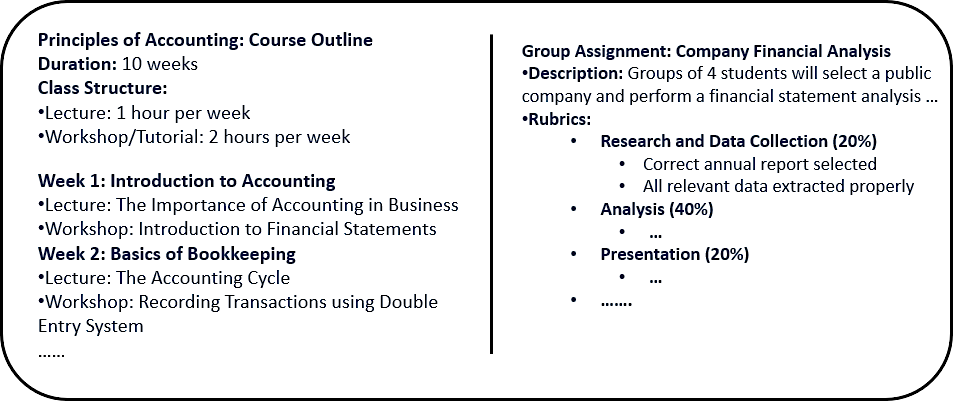
Figure 1: Example of a course guideline rubric output generated by GPT-4 in response to a dedicated teaching prompt.
- Content Creation: Outlining, iterative revision, and plot control frameworks (e.g., DOC, Re3) showcase how prompt engineering improves long-text coherence and stylistic alignment.
- Programming: Multi-turn prompts, retrieval-augmented context for code generation, and self-debugging loops elevate LLMs as software engineering co-pilots, with demonstrable advances over baseline code synthesis.
- Dataset Generation: Synthetic data and annotation tasks are enhanced through prompt-based bootstrapping, especially for low-resource classification and in-context learning calibration.
Prospective Directions and Implications
The authors forecast critical future directions:
- Structural Understanding: Enhanced interpretability of LLM internals, including attention and node-weight dynamics, will enable more effective control via prompt design.
- Agentic LLMs: The ongoing evolution from static prompt templates to autonomous, agentic, multi-model systems will require meta-prompting interfaces and new paradigms for chaining, memory, planning, and tool utilization.
Conclusion
This survey establishes prompt engineering as a critical, methodology-rich axis for maximizing LLM efficacy. Both foundational and advanced prompting techniques are required to control output distribution, mitigate hallucination, and direct agentic systems. A strong interdependency is noted between prompt structure, task complexity, and evaluation strategy. The work underscores that systematic research into prompt engineering underpinning LLMs is essential, and that expansion into agentic interfaces and more robust evaluation methodologies is imminent. As the scale of LLM deployments broadens, prompt engineering remains a key site for practical innovation and theoretical inquiry.

