Papers
Topics
Authors
Recent
2000 character limit reached

Understanding Addition in Transformers (2310.13121v9)

Published 19 Oct 2023 in cs.LG and cs.AI

Abstract: Understanding the inner workings of machine learning models like Transformers is vital for their safe and ethical use. This paper provides a comprehensive analysis of a one-layer Transformer model trained to perform n-digit integer addition. Our findings suggest that the model dissects the task into parallel streams dedicated to individual digits, employing varied algorithms tailored to different positions within the digits. Furthermore, we identify a rare scenario characterized by high loss, which we explain. By thoroughly elucidating the model's algorithm, we provide new insights into its functioning. These findings are validated through rigorous testing and mathematical modeling, thereby contributing to the broader fields of model understanding and interpretability. Our approach opens the door for analyzing more complex tasks and multi-layer Transformer models.

Definition Search Book Streamline Icon: https://streamlinehq.com
References (20)
  1. System iii: Learning with domain knowledge for safety constraints, 2023.
  2. Network dissection: Quantifying interpretability of deep visual representations. Proceedings of the IEEE conference on computer vision and pattern recognition, pages 3319–3327, 2017.
  3. Measuring disentanglement: A review of metrics, 2022.
  4. Towards automated circuit discovery for mechanistic interpretability, 04 2023a.
  5. Towards automated circuit discovery for mechanistic interpretability, 2023b.
  6. A mathematical framework for transformer circuits. https://transformer-circuits.pub/2021/framework/index.html, 2021.
  7. Toy models of superposition, 2022.
  8. Neuron to graph: Interpreting language model neurons at scale, 2023.
  9. Transformer feed-forward layers are key-value memories. In Proceedings of the 2021 Conference on Empirical Methods in Natural Language Processing, pages 5484–5495, Online and Punta Cana, Dominican Republic, Nov. 2021. Association for Computational Linguistics. doi: 10.18653/v1/2021.emnlp-main.446. URL https://aclanthology.org/2021.emnlp-main.446.
  10. How does information bottleneck help deep learning?, 2023.
  11. Locating and editing factual associations in gpt. https://proceedings.neurips.cc/paper_files/paper/2022/file/6f1d43d5a82a37e89b0665b33bf3a182-Paper-Conference.pdf, 2022.
  12. R. Miikkulainen. Creative ai through evolutionary computation: Principles and examples. https://doi.org/10.1007/s42979-021-00540-9, 2021.
  13. N. Nanda and T. Lieberum. Mechanistic interpretability analysis of grokking. https://www.alignmentforum.org/posts/N6WM6hs7RQMKDhYjB, 2022.
  14. Progress measures for grokking via mechanistic interpretability, 2023.
  15. Zoom in: An introduction to circuits. https://distill.pub/2020/circuits/zoom-in/, 2020a.
  16. Zoom in: An introduction to circuits. Distill, 5(3):e00024.001, 2020b.
  17. Deep symbolic regression: Recovering mathematical expressions from data via risk-seeking policy gradients. Advances in Neural Information Processing Systems, 34, 2021.
  18. Toward transparent ai: A survey on interpreting the inner structures of deep neural networks. arXiv preprint arXiv:2207.13243, 2022.
  19. A. K. Seth. Causal connectivity of evolved neural networks during behavior. Network: Computation in Neural Systems, 16(1):35–54, 2005. doi: 10.1080/09548980500238756. URL https://doi.org/10.1080/09548980500238756.
  20. J. Vig. A multiscale visualization of attention in the transformer model. arXiv preprint arXiv:1906.05714, 2019.
Citations (12)

Summary

  • The paper reveals that the transformer partitions arithmetic into parallel digit-specific operations, improving interpretability.
  • It identifies a 'double staircase' attention pattern, demonstrating sequential digit pairing and specialized MLP roles in addition.
  • The study uses per-digit loss analysis and ablation experiments to highlight challenges with cascading carries and complex arithmetic dependencies.

Understanding Addition in Transformers

Introduction

The paper "Understanding Addition in Transformers" (2310.13121) explores the mechanistic interpretability of transformer models, specifically focusing on how a single-layer transformer performs nn-digit integer addition. The research reveals that transformers partition the addition task into parallel streams, each dedicated to individual digits, and utilize distinct algorithms across different digit positions. This study offers insights into the operational intricacies of transformers, providing potential implications for broader AI safety and alignment concerns.

Model Architecture and Attention Patterns

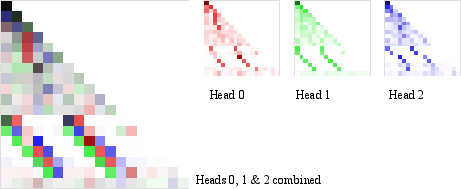
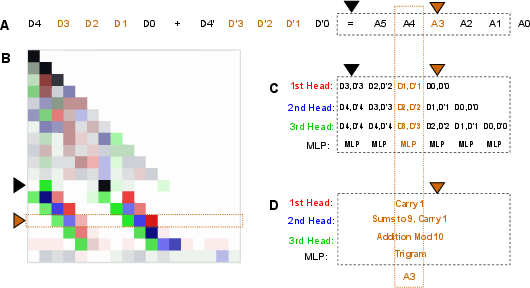
The study leverages a one-layer transformer model tasked with nn-digit integer addition. The model processes input sequences through a self-attention mechanism followed by MLPs to output results in a contextually enriched format. Key insights are drawn from examining attention patterns where, notably, a "double staircase" pattern arises, representing how the model attends to digit pairs sequentially from left to right (Figure 1). Figure 1

Figure 1: The transformer model's attention pattern during the addition of two 5-digit integers.

This pattern highlights the temporal structuring of operations, wherein each attention head attends to distinct digit pairs in a staggered sequence, enabling the model to handle arithmetic tasks by abstraction of sequential token information.

Training Dynamics and Loss Analysis

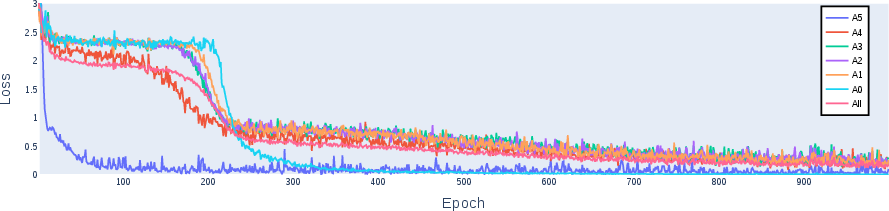
The model's training was evaluated across several dimensions, revealing a semi-independent learning process for each digit, signified by the distinct per-digit loss curves (Figure 2). The model trains each answer digit individually, with the first digit being learned more quickly due to its simplicity (always 1 or 0). Figure 2

Figure 2: Per-digit training loss curves for 5-digit integer addition.

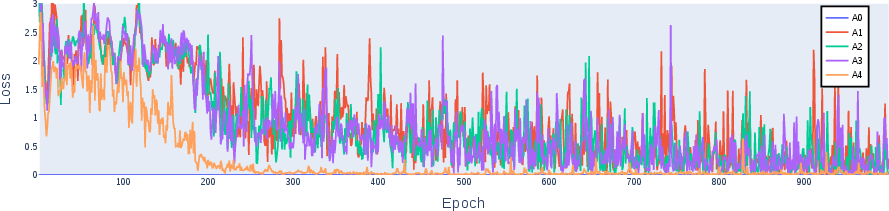
Further analysis showed the model's difficulty in handling specific rare cases, such as cascading carries in digits, which result in higher loss variability (Figure 3). This finding indicates the model's limitations in managing complex arithmetic dependencies inherent in more convoluted addition scenarios. Figure 3

Figure 3: Variation in per-digit training loss linked to cascading cases, such as 445+555=1000.

Mathematical Framework

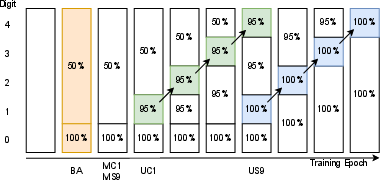
The paper introduces a mathematical framework comprising foundational and compound tasks that the transformer executes to perform addition. The framework explains how tasks such as royalblue (summing two digits modulo 10) and royalblue (carry-over determination) are incrementally discovered and refined during training. This framework facilitates the understanding of task-specific learning progressions within the model (Figure 4). Figure 4

Figure 4: Predicted training task learning order and dependencies for achieving zero loss in addition.

Algorithmic Insights and Predictions

Detailed algorithms for digit-wise addition are explored using ablation studies, confirming that each digit is calculated one step before being revealed. The model employs distinct subroutines across different digit groups—for instance, higher-value digits leverage additional computational resources compared to their counterparts. Ablation experiments validate these distinctions, linking specific attention heads and MLP components to particular arithmetic subtasks (Figure 5). Figure 5

Figure 5: The model's attention pattern for a 5-digit addition task using 3 attention heads.

Conclusions and Future Directions

The research provides a methodology for decoding the intricate operations within transformer architectures, specifically addressing integer addition. This approach has broader implications for AI systems by enhancing transparency and elucidating their decision-making processes. Future work may extend these insights to more complex operations such as subtraction and multiplication, potentially harnessing structured algorithms discovered herein as foundational components for learning new arithmetic functions.

The paper indicates that while current models can handle certain arithmetic tasks effectively, they struggle with nuanced scenarios requiring cascading calculations. Addressing these challenges remains a promising area for further research, aiming to bolster the robustness and interpretability of transformer-based AI systems.

Whiteboard

Paper to Video (Beta)

Open Problems

We haven't generated a list of open problems mentioned in this paper yet.

Collections

Sign up for free to add this paper to one or more collections.

Tweets

Sign up for free to view the 4 tweets with 19 likes about this paper.