EasyEdit: An Easy-to-use Knowledge Editing Framework for Large Language Models
Abstract: LLMs usually suffer from knowledge cutoff or fallacy issues, which means they are unaware of unseen events or generate text with incorrect facts owing to outdated/noisy data. To this end, many knowledge editing approaches for LLMs have emerged -- aiming to subtly inject/edit updated knowledge or adjust undesired behavior while minimizing the impact on unrelated inputs. Nevertheless, due to significant differences among various knowledge editing methods and the variations in task setups, there is no standard implementation framework available for the community, which hinders practitioners from applying knowledge editing to applications. To address these issues, we propose EasyEdit, an easy-to-use knowledge editing framework for LLMs. It supports various cutting-edge knowledge editing approaches and can be readily applied to many well-known LLMs such as T5, GPT-J, LlaMA, etc. Empirically, we report the knowledge editing results on LlaMA-2 with EasyEdit, demonstrating that knowledge editing surpasses traditional fine-tuning in terms of reliability and generalization. We have released the source code on GitHub, along with Google Colab tutorials and comprehensive documentation for beginners to get started. Besides, we present an online system for real-time knowledge editing, and a demo video.
Paper Prompts
Sign up for free to create and run prompts on this paper.
Top Community Prompts
Explain it Like I'm 14
EasyEdit: A simple way to “edit” what big AI models know
Overview
This paper introduces EasyEdit, a tool that lets people quickly and safely “edit” the knowledge inside LLMs like LLaMA, GPT-J, or T5. Why? Because LLMs often have a knowledge cutoff (they don’t know about newer events) and sometimes say things that aren’t true. EasyEdit helps update or fix specific facts inside a model without having to retrain the whole thing.
What questions does the paper try to answer?
The paper focuses on a few simple questions:
- How can we update a model’s knowledge about one fact (like who the U.S. president is) without messing up everything else it knows?
- Can we do these edits quickly and with less computing power than full fine-tuning?
- Can we provide one simple, unified toolkit that supports many editing methods and many models?
- How do we measure whether an edit works well and doesn’t cause unwanted side effects?
How does EasyEdit work? (Methods and analogies)
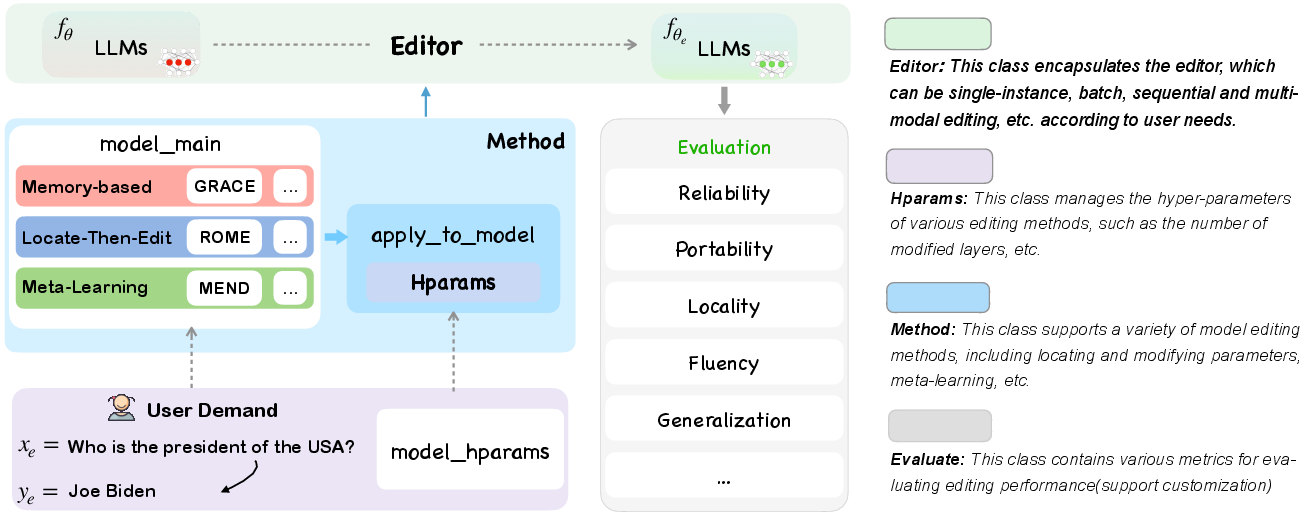
Think of an LLM as a huge digital encyclopedia mixed with a brain. Sometimes you need to fix one page (a fact) without rewriting the whole book or causing other pages to change. EasyEdit is like a neat toolbox that:
- Organizes different editing techniques in one place.
- Works with many popular models (T5, GPT-J, GPT-Neo, GPT-2, LLaMA, LLaMA-2).
- Lets you edit one fact, many facts at once, or do a series of edits over time.
To keep things understandable, here are the main ideas:
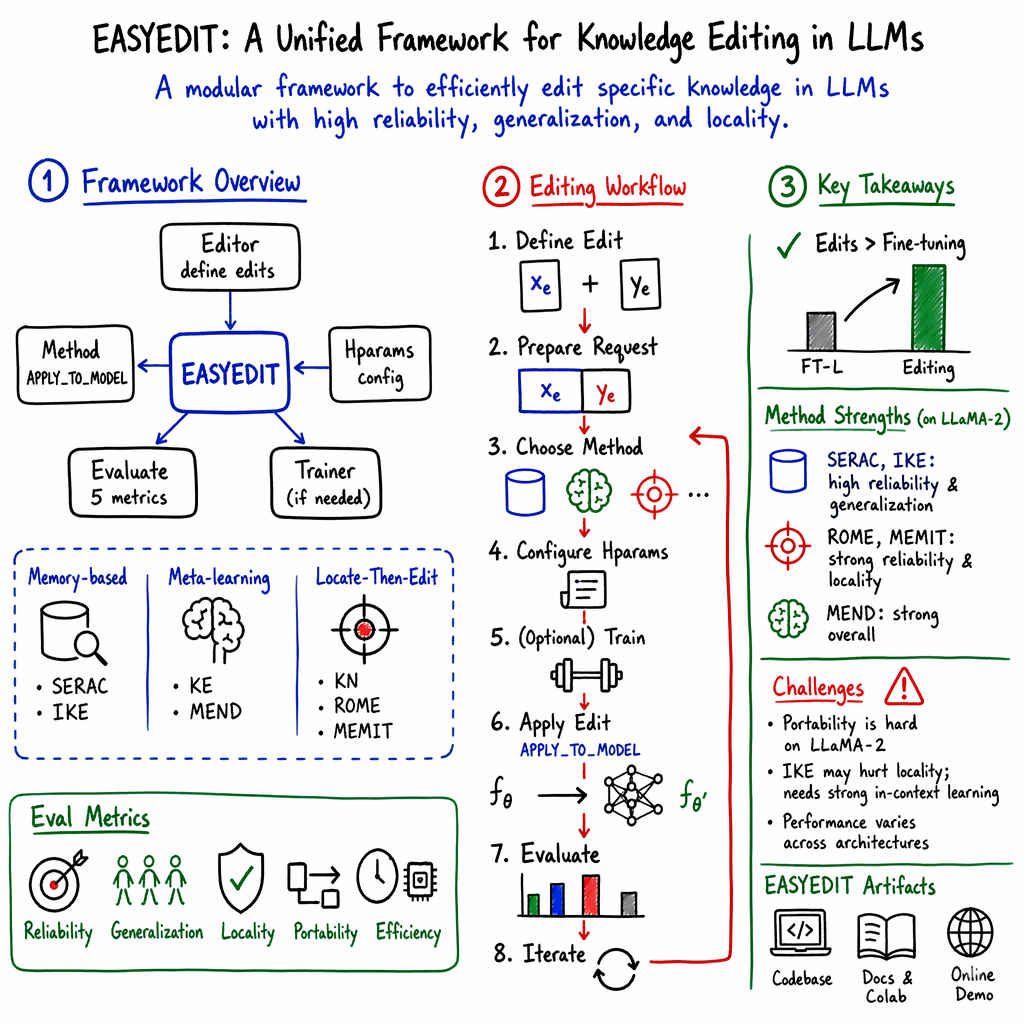
- Three families of editing methods:
- Memory-based (like keeping a sticky note next to the book): Store the corrected fact outside or alongside the model and use it when needed. Examples: SERAC, IKE.
- Meta-learning (like teaching a small helper to nudge the book’s text correctly): A separate “editor” network learns how to adjust the model’s parameters smartly. Examples: KE, MEND.
- Locate-then-edit (like finding the exact sentence in the book and changing it): Identify which “neurons” or layers store the fact and edit them directly. Examples: ROME, MEMIT, KN.
- EasyEdit’s key parts (with simple analogies):
- Editor: The front door. You tell it “Here’s the question and the correct new answer,” and it runs the edit.
- Method: The tool you pick for editing (like choosing a pencil, eraser, or sticky note).
- Evaluate: The quality checker. It tests if the edit worked and checks for side effects.
- Hparams (hyperparameters): The settings (like which layer to change or how big the change should be).
- Trainer: Used when a method needs extra training (like teaching the helper editor how to make good edits).
- What does “good editing” mean? EasyEdit measures it with plain ideas:
- Reliability: Does the model give the new, correct answer for the edited question?
- Generalization: Does it also answer similar versions of the question correctly?
- Locality: Did we avoid breaking unrelated facts?
- Portability: Does the new fact help in related questions (like connecting facts in one “hop”)?
- Efficiency: How fast and memory-friendly is the edit?
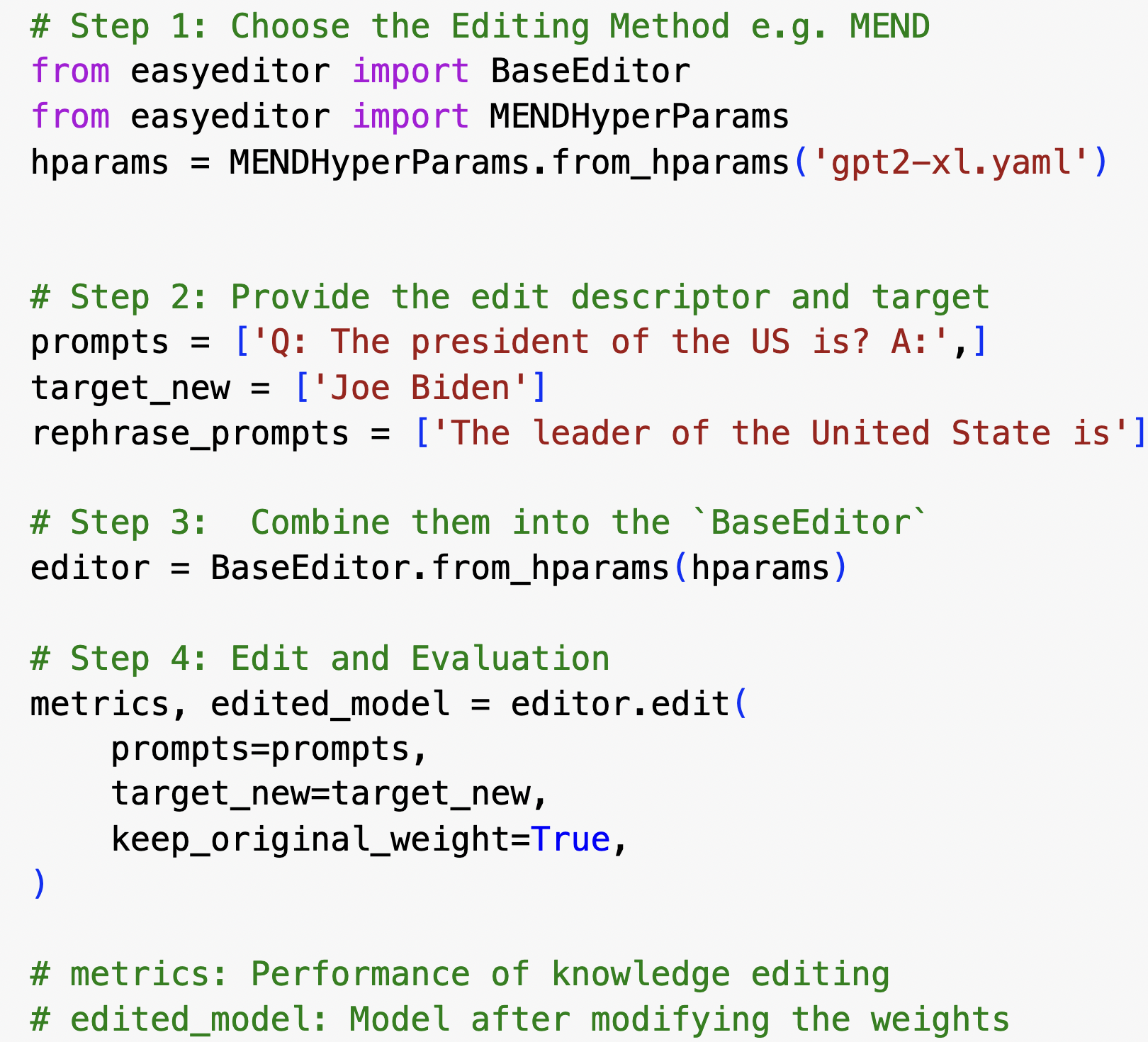
- A simple example:
- You want the model to say “Joe Biden” when asked “Who is the president of the USA?” EasyEdit can apply an editing method (like MEND) so the model updates that fact without retraining everything.
What did they test and what did they find?
The authors used LLaMA‑2 (7B) and a question-answer dataset (ZsRE) to compare multiple editing methods inside EasyEdit. Here’s what they found, in everyday terms:
- Compared to normal fine-tuning:
- Knowledge editing methods are more reliable (they hit the edited answer more often) and generalize better (they answer similar questions correctly), especially when you only need to change a few facts.
- Highlights across methods:
- SERAC (memory-based): Extremely reliable and keeps unrelated facts safe, but struggles to spread the updated fact to related questions (low portability).
- IKE (in-context editing): Nearly perfect at giving the edited answer and handling similar questions (great reliability and generalization), and it spreads updated facts better than most. However, it can sometimes affect unrelated questions (weaker locality) and depends on the model being good at in-context learning.
- ROME and MEMIT (locate-then-edit): Very good at hitting the edited answer and not breaking other facts (reliability/locality), but not as strong at generalizing to rephrased questions.
- MEND (meta-learning): Strong overall balance—good reliability, good generalization, and good locality.
- FT-L (a kind of fine-tuning limited to one layer): Much worse than ROME even though they touch the same layer. This suggests standard fine-tuning (even small) isn’t ideal for precise knowledge edits.
- KN: Performed poorly here (may suit smaller models or different tasks).
- Portability is hard:
- Most methods found it difficult to make the new fact “ripple” naturally into related questions on LLaMA‑2. Past work showed better portability on other models (like GPT-J), so the model’s architecture matters.
Why is this important?
- You can fix or update a model without expensive retraining and without hurting its other abilities.
- This is useful for:
- Keeping models up to date (e.g., new leaders, new discoveries).
- Correcting harmful or biased outputs.
- Quickly adapting a model to a new setting or user need.
- EasyEdit also lowers the barrier for researchers and developers:
- One unified interface across many methods and models.
- Clear testing metrics.
- Open-source code, tutorials, and even an online demo for real-time edits.
What could this change in the future?
- Faster updates: News changes, and so can the model—without a full retrain.
- Safer AI: Targeted edits can reduce toxic or biased outputs more carefully.
- Smarter customization: Apps can “teach” a model specific facts or behaviors on the fly.
- New research: A shared framework makes it easier to invent and compare new editing methods, and to extend editing to multimodal models (text + images, etc.) or even edit “personality.”
Key takeaways
- LLMs can be “edited” like fixing a single page in a huge book, instead of rewriting the whole thing.
- EasyEdit bundles many editing tools under one roof and shows how to test them fairly.
- On LLaMA‑2, editing methods often beat fine-tuning for small, precise fixes.
- Different methods have different strengths: some are great at not breaking anything (locality), others are better at spreading the new fact (portability).
- The code, docs, and demos make it practical to try this in real projects.
Practical Applications
Below are practical, real-world applications derived from the EasyEdit framework’s findings, methods, and innovations. Each item specifies sectors, potential tools/workflows, and key dependencies that affect feasibility.
Immediate Applications
- Targeted factual updates for production chatbots (software, e-commerce, finance, media)
- Use case: Patch product specs, pricing, policy changes, or known factual errors in deployed LLM assistants without full fine-tuning.
- Tools/workflows: “Editing dashboard” built on EasyEdit (Editor + APPLY_TO_MODEL + Evaluate) with batch/sequential edit support; CI/CD gating using Reliability/Locality metrics; rollback via stored pre-edit weights.
- Assumptions/dependencies: Access to model weights for white-box edits (e.g., LLaMA-2, GPT-J); small compute for ROME/MEMIT/MEND; clear edit descriptors and targets; limited expectation for portability beyond the edited fact.
- Safety hotfixes to reduce harmful/toxic outputs (software, platforms, trust & safety)
- Use case: Rapidly modify model behavior to mitigate offensive or biased generations in specific contexts (e.g., disallowed slurs, harassment).
- Tools/workflows: Memory-based (SERAC) or locate-then-edit (ROME/MEMIT) pipelines with Locality tests to ensure minimal collateral effects; “safety patch bundles.”
- Assumptions/dependencies: Safety review process; dependable Locality evaluations; risk that edits may not address deep/general biases—must be scoped and monitored.
- Up-to-date policy and compliance assistants (policy, legal, finance)
- Use case: Update internal policy assistants with new regulations (e.g., tax rules, privacy updates) without retraining.
- Tools/workflows: Sequential edits as regulations evolve; Evaluate module to confirm no drift on out-of-scope knowledge; audit logs for edit provenance.
- Assumptions/dependencies: Legal sign-off; white-box access recommended; low portability implies edits may not reliably propagate to multi-hop reasoning.
- Healthcare guideline refresh for non-clinical tasks and internal tools (healthcare)
- Use case: Incorporate changes to public health recommendations, drug label updates, or patient education materials in informational assistants.
- Tools/workflows: MEND/ROME edits with rigorous Locality and Reliability checks; integration into approval workflows; shadow deployment before release.
- Assumptions/dependencies: Not for high-stakes clinical decision support without formal validation; compliance and governance review; careful scoping due to observed low portability on LLaMA-2.
- Data privacy and “right to be forgotten” micro-removals (policy, compliance, software)
- Use case: Suppress or correct specific personal data memorization issues discovered in a deployed model.
- Tools/workflows: Locate-then-edit (ROME/MEMIT) combined with Locality and regression tests; edit registry for auditability and rollback.
- Assumptions/dependencies: Feasibility depends on accessibility of model internals; edits must be validated to avoid undesired generalization; not a substitute for upstream data governance.
- Knowledge editing as an MLOps capability (software/DevOps)
- Use case: Establish a standardized, auditable “edit pipeline” with metrics (Reliability, Generalization, Locality, Efficiency) as quality gates.
- Tools/workflows: EasyEdit integrated into CI/CD; batch and sequential edit orchestration; automatic metric reporting and canary tests; Colab tutorials and online demo for ops training.
- Assumptions/dependencies: Engineering capacity to integrate EasyEdit; governance for approval and rollback; monitoring for drift over time.
- Academic benchmarking and curriculum (academia, education)
- Use case: Compare SERAC, IKE, MEND, ROME, MEMIT across models; teach students about knowledge localization, meta-learning editors, and evaluation metrics.
- Tools/workflows: EasyEdit’s unified interface and evaluation suite; paper’s LLaMA-2 + ZsRE setup reproducible for labs; assignment-ready Colab notebooks.
- Assumptions/dependencies: Access to open-source checkpoints; compute for training hypernetworks (MEND) if used.
- Rapid incident response for public-facing LLMs (software, media, customer service)
- Use case: Patch emergent errors (e.g., news misstatement, mislabeled entities) in real time while a longer-term fix is prepared.
- Tools/workflows: Online editing system for quick triage; Evaluate module to ensure locality; versioned edit catalog.
- Assumptions/dependencies: White-box models preferred; for black-box APIs, use IKE-style in-context edits with reduced guarantees on Locality.
- Domain personalization and “brand voice” alignment (marketing, CX)
- Use case: Adjust tone/style or factual stances (e.g., house style guide) in a bounded, testable way.
- Tools/workflows: Sequential edits capturing brand rules; Locality checks to prevent unintended global tone shifts; release via MLOps pipeline.
- Assumptions/dependencies: Clear style descriptors; safety review to avoid reinforcing biases; personality editing is flagged as future work—keep scope limited.
- RAG systems with surgical patches for persistent facts (software, knowledge management)
- Use case: Where retrieval context is unreliable or long, surgically patch persistent facts into the model while keeping RAG for dynamic content.
- Tools/workflows: Hybrid workflow—use EasyEdit for stable facts and RAG for fast-changing items; evaluate Locality versus RAG prompt sensitivity.
- Assumptions/dependencies: Editorial policy defining “persistent” vs “ephemeral” facts; RAG and editing must be jointly tested to avoid contradictions.
Long-Term Applications
- High-stakes clinical decision support updates (healthcare)
- Use case: Safely embed new clinical guidelines or alerts into CDS systems with provable locality and generalization.
- Tools/workflows: Certified pipelines with rigorous validation (Reliability, Locality, Portability), audit trails, and post-market monitoring; potential third-party certification of edits.
- Assumptions/dependencies: Regulatory approvals; improved portability across architectures; formal verification of edits; extensive testing on domain datasets.
- Enterprise-scale continuous editing and knowledge lifecycle management (software, enterprise IT)
- Use case: Stream data-driven edits (thousands/millions) with deduplication, dependency tracking, and conflict resolution.
- Tools/workflows: Edit registries, dependency graphs, automatic impact analysis; scheduler for batch/sequential edits; alignment with data governance catalogs.
- Assumptions/dependencies: Scalability of edit methods (e.g., MEMIT for batch) and monitoring; automated detection of contradictory edits; robust rollback strategies.
- Black-box model editing at scale with strong guarantees (software, platforms)
- Use case: Reliable edits for closed APIs (e.g., GPT-4-like systems) with controllable locality.
- Tools/workflows: Advanced in-context editing (beyond IKE) with stability guarantees; prompt routers and classifiers; contractual support from API providers for edit hooks.
- Assumptions/dependencies: Today’s IKE shows high reliability/generalization but weaker locality; requires research to improve locality guarantees and reduce prompt sensitivity.
- Robust portability and multi-hop knowledge propagation (all sectors)
- Use case: Edits that naturally ripple to related facts (e.g., change a CEO and all queries about leadership reflect this).
- Tools/workflows: New methods that raise Portability on modern architectures (LLaMA-2 showed low portability for ROME/MEMIT); automated tests for 1–2 hop generalization.
- Assumptions/dependencies: Methodological advances; architecture-aware techniques; larger contextual evaluations.
- Multi-modal model editing (software, robotics, manufacturing, education)
- Use case: Update image/video-LLMs with new object names, safety rules, or procedures (e.g., robotics operating constraints).
- Tools/workflows: Extensions of EasyEdit to vision-language layers and attention maps; cross-modal Locality metrics; simulation-in-the-loop testing.
- Assumptions/dependencies: Framework support for multi-modal architectures; domain datasets and simulators; safety validation.
- Safety/certification frameworks for editable LLMs (policy, standards, compliance)
- Use case: Standardized processes and reporting (e.g., edit manifests, metrics thresholds) recognized by regulators and auditors.
- Tools/workflows: Industry standards for edit logs, metric cutoffs (e.g., Locality ≥ X), and independent auditing; policy-aligned governance.
- Assumptions/dependencies: Cross-industry consensus; empirical evidence that metrics predict field safety; legal frameworks for “model patching.”
- Automated detection-to-edit pipelines (software, trust & safety, media)
- Use case: Detect factual drift or safety issues in monitoring, propose candidate edits, auto-test, and apply with human-in-the-loop approval.
- Tools/workflows: Monitoring → candidate generation → EasyEdit apply_to_model → Evaluate → approval and release; anomaly detection and knowledge diffing.
- Assumptions/dependencies: Reliable detectors and knowledge bases; risk control for false positives; sophisticated test suites.
- Robotics and autonomous systems behavior tuning (robotics, mobility)
- Use case: Quickly adjust language-guided planning modules with new operating rules or environment facts without retraining core policies.
- Tools/workflows: Edits to planner LLMs coupled with simulation-based Locality evaluation; safety-case documentation of each edit.
- Assumptions/dependencies: Integration with control stacks; safety validation; stronger guarantees needed before real-world deployment.
- Energy and industrial operations playbook updates (energy, manufacturing)
- Use case: Embed updated SOPs, hazard handling, and compliance requirements into maintenance assistants and shift support tools.
- Tools/workflows: Batch edits aligned to SOP releases; Locality and regression tests on procedure corpora; integration with asset management systems.
- Assumptions/dependencies: Domain validation; union/regulatory approvals; robustness against misgeneralization across plants.
- Personalized assistants with persistent, privacy-preserving edits (daily life, education)
- Use case: Long-term personal preference and fact patches (family names, devices, routines) that remain stable across sessions.
- Tools/workflows: On-device editable models; sequential edits with locality checks; encrypted edit registries.
- Assumptions/dependencies: Efficient on-device editing; privacy protections; UI for user-controlled edits and rollbacks.
Notes on feasibility across the board
- White-box vs. black-box access: Most precise methods (ROME/MEMIT/MEND) need model weights; in-context (e.g., IKE) can work with black-box APIs but may weaken locality and stability.
- Architecture sensitivity: Results vary by base model (e.g., portability drop on LLaMA-2); test per-architecture before wide deployment.
- Compute constraints: Meta-learning editors (MEND/KE) require training hypernetworks/classifiers; plan VRAM/time budgets.
- Evaluation is critical: Use EasyEdit’s Reliability, Generalization, Locality, Portability, and Efficiency metrics as gates; high-stakes domains require stricter thresholds and domain-specific tests.
- Scope creep risks: Edits should be narrowly defined; sequential and batch edits require conflict management and regression testing.

