SAM-RL: Sensing-Aware Model-Based Reinforcement Learning via Differentiable Physics-Based Simulation and Rendering
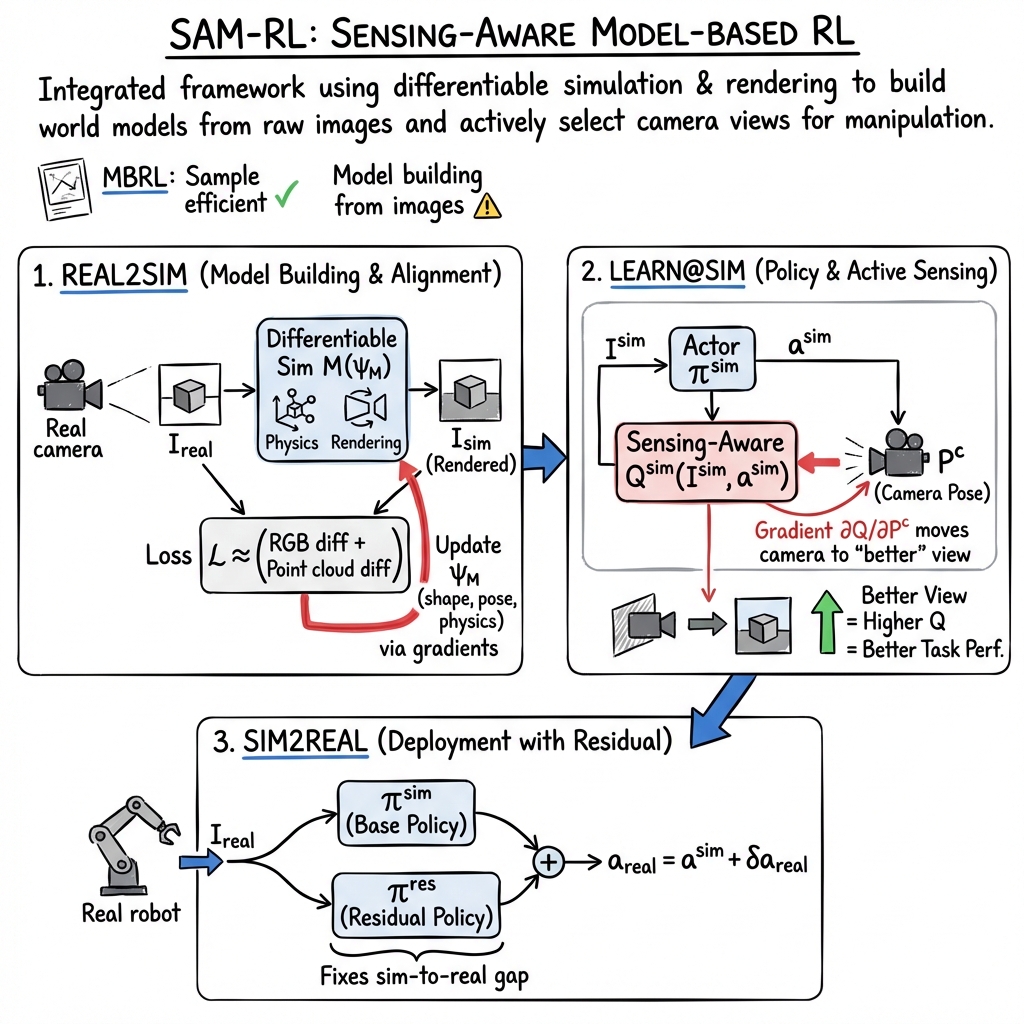
Abstract: Model-based reinforcement learning (MBRL) is recognized with the potential to be significantly more sample-efficient than model-free RL. How an accurate model can be developed automatically and efficiently from raw sensory inputs (such as images), especially for complex environments and tasks, is a challenging problem that hinders the broad application of MBRL in the real world. In this work, we propose a sensing-aware model-based reinforcement learning system called SAM-RL. Leveraging the differentiable physics-based simulation and rendering, SAM-RL automatically updates the model by comparing rendered images with real raw images and produces the policy efficiently. With the sensing-aware learning pipeline, SAM-RL allows a robot to select an informative viewpoint to monitor the task process. We apply our framework to real world experiments for accomplishing three manipulation tasks: robotic assembly, tool manipulation, and deformable object manipulation. We demonstrate the effectiveness of SAM-RL via extensive experiments. Videos are available on our project webpage at https://sites.google.com/view/rss-sam-rl.
Paper Prompts
Sign up for free to create and run prompts on this paper.
Top Community Prompts
Knowledge Gaps
Knowledge gaps, limitations, and open questions
The following points summarize what remains missing, uncertain, or unexplored in the paper, stated concretely to guide future research:
- Robustness to imperfect perception: the method assumes accurate instance segmentation for a single target object; the impact of segmentation errors, multi-object segmentation, cluttered backgrounds, and occlusions on model updates and policies is not evaluated.
- Photometric realism and calibration: the RGB loss does not model illumination, exposure, white balance, or camera response; methods to estimate lighting and photometric parameters (and their effect on differentiable rendering-based updates) are absent.
- Physical parameter identification scope: updates are limited to mass and inertia; crucial contact and deformation parameters (friction, damping, stiffness/compliance, restitution) are not estimated, especially important for contact-rich and deformable tasks.
- Identifiability of system parameters: updating physical parameters from a single end pose (or few observations) is underdetermined; principled approaches to identifiability, regularization, multi-trajectory estimation, and uncertainty quantification are missing.
- Deformable object modeling fidelity: thread modeled as rigid links with revolute joints; generalization to continuum elasticity or more realistic deformable models is not demonstrated, and parameter learning for deformables (e.g., stiffness) is unexplored.
- Action space limitations: policies only control 3D translation (rotations disabled, gripper actions unspecified); extension to full 6-DoF control, end-effector orientation, force/torque commands, and richer manipulators remains open.
- Camera viewpoint optimization constraints: gradient-based updates do not enforce kinematic reachability, collision avoidance, joint limits, or time/motion budgets of the camera arm; a constrained optimization/planning formulation is needed.
- NBV baseline comparison: no quantitative comparison against established NBV methods (information gain heuristics, coverage-based, learning-based) to isolate the benefit of Q-based viewpoint selection.
- Stability of actor–critic coupling: the circular dependence (actor outputs actions, Q guides camera pose that changes observations) lacks analysis of convergence, local optima, and stability under noisy gradients or non-smooth rendering/contacts.
- Viewpoint change overhead: the trade-off between moving the camera (time, energy, collision risk) and task performance is not measured; policies to limit or plan view changes across a horizon are not studied.
- Sparse reward for residual RL: residual policy is trained with binary success signals; strategies for shaping, safety-constrained exploration, and guarantees that residuals do not degrade performance under exploration are not examined.
- Baseline fairness and external validity: comparisons to TD3/SAC/Dreamer are conducted in PyBullet with PyBullet as the “real world”; equivalence of observation/action spaces, reward shaping, and transferability to physical hardware are not established.
- Sim-to-real generalization: robustness to variations in object geometry, material, texture, lighting, and sensor characteristics is not quantified; domain randomization or uncertainty-aware training strategies are not explored.
- Rendering-based loss robustness: sensitivity to sensor artifacts (missing depth, specular/transparent surfaces, motion blur, rolling shutter) and adverse lighting is untested; reliance on masked RGB and EMD depth may be brittle in practice.
- Multi-object and cluttered scenes: the pipeline focuses on a single object; scaling to multiple interacting objects, simultaneous tracking/model updates, and the effect of mutual occlusions are open problems.
- Automatic success detection: Needle-Threading success is manually judged; scalable and precise automatic success metrics and detectors for deformable tasks are needed.
- Calibration sensitivity: the effect of errors in camera intrinsics, hand–eye calibration, and robot base-to-base transforms on model accuracy, viewpoint optimization, and policy performance is not analyzed.
- Computation and real-time feasibility: end-to-end latency of differentiable simulation + rendering + camera optimization on-robot is not reported; profiling, real-time constraints, and hardware acceleration requirements remain unclear.
- Acceptance criterion and oscillations: simple “accept if Q increases” may induce jitter or oscillations; smoothing, hysteresis, or planning-based camera selection is not developed.
- Expert trajectory generation scalability: reliance on trajectory optimization in differentiable simulators may fail or be costly for complex tasks; fallback strategies, warm starts, or learning-from-demonstration integration are not investigated.
- Loss component ablation: contributions of RGB vs depth (EMD) terms to model fidelity and downstream policy performance are not quantified; alternative geometric losses (e.g., signed distance, ICP variants) are not compared.
- Dual-arm coordination safety: collision avoidance and coordination between the camera arm (Flexiv) and the manipulation arm (Franka) during dynamic viewpoint changes are not addressed.
- Failure modes and diagnostics: systematic characterization of when SAM-RL fails (e.g., severe occlusion, fast dynamics, contact discontinuities, poor textures) and diagnostic tools to recover are absent.
- Reproducibility: full details on hyperparameters, training schedules, datasets of camera views, trajectory optimizer settings, and code availability are insufficient for replication; incomplete equations and typos hinder clarity.
- Metrics beyond success rate: real-world sample efficiency (episodes, wall-clock time), robustness across seeds, and safety metrics are not reported; statistical significance and confidence intervals are missing.
- Multi-step NBV planning: viewpoint selection is greedy gradient ascent; planning sequences of views with lookahead, task-aware costs, and joint optimization of perception and action over a horizon remains open.
- Handling non-differentiable events: reliability of gradients through contact-rich dynamics (impacts, stick–slip) is unexamined; smoothing strategies or subgradient methods for discontinuities are not described.
- Environment rendering fidelity: background textures, environment geometry, and lighting are not modeled/updated; strategies for full-scene photometric/geomtric alignment to reduce sim–real discrepancy are needed.
- Multi-modal sensing: integration of additional sensing modalities (force/torque, tactile, proprioception) for model update and viewpoint selection is not explored.
- POMDP formulation clarity: the paper references POMDPs but does not formally define the observation model, belief updates, or the role of active sensing within a POMDP framework; a principled formulation is lacking.

