- The paper introduces an ODE-RNN architecture that models continuous latent dynamics from irregular time series data using neural ODEs.
- It integrates ODE-RNNs within a variational autoencoder framework to improve interpretability and quantify uncertainty on sparse datasets.
- Experimental results demonstrate that Latent ODEs outperform traditional RNNs in interpolation and extrapolation tasks across diverse data sets.
Overview
"Latent ODEs for Irregularly-Sampled Time Series" presents innovative approaches for modeling time series data with varying sample intervals using a framework of neural ordinary differential equations (Neural ODEs). The paper introduces ODE-RNNs, which generalize RNNs to operate in continuous time, yielding models better suited for irregularly-sampled datasets. These methods include the incorporation of Latent ODEs using ODE-RNNs as the recognition network, facilitating more accurate data handling by approximating continuous latent state dynamics.
The ODE-RNN Framework
ODE-RNNs extend traditional RNNs by modeling continuous-time dynamics through neural ODEs. Unlike traditional RNNs that rely on discretized timelines, ODE-RNNs define the hidden state as the solution of an ODE initial-value problem across observation gaps. This provides greater modeling flexibility and reduces the need for preprocessing such as time-bin discretization or data imputation.
Algorithm Structure
The ODE-RNN alternates between solving an ODE for the hidden state evolution and updating this state with new observations using standard RNN update mechanisms. This architecture enables dynamic state evolution that adapts to the timing of observations without bias towards predefined discrete intervals (Algorithm 1).
Evaluation and Application
ODE-RNNs were evaluated on tasks requiring interpolation and extrapolation of time series data. They outperformed several RNN variants, especially when dealing with sparse observations, given their resilience to irregular sampling intervals.
Latent ODEs
The concept of Latent ODEs integrates the ODE-RNN into a sophisticated encoder-decoder model in a variational autoencoder (VAE) framework. This methodology emphasizes disentangling latent space dynamics (encoded through an ODE) from data observation dependencies, offering advantages in interpretability and uncertainty quantification.
Model Architecture
Within this framework, the encoder utilizes an ODE-RNN to produce a posterior distribution over the initial state. The generative process evolves deterministically from this latent state using an ODE model, facilitating robust system recovery from limited data points.
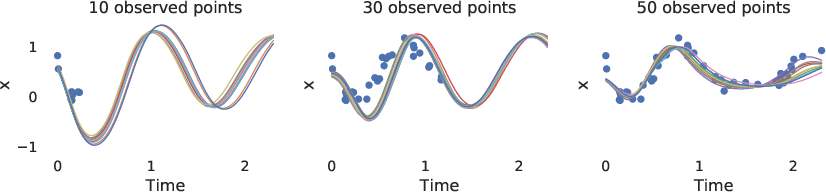
Figure 1: Conditioning on increasing number of observations.
Experimentation and Results
The paper presents comprehensive experimental validation across multiple datasets, demonstrating notable improvements over conventional methods. Notably, the Latent ODEs consistently excel in both interpolating sparse data and extrapolating beyond the training dataset intervals.
Numerical Evaluation
For benchmarking, performance across different settings—including sparse observation extrapolation and continuous latent space capture—illustrated the model's efficacy. In particular, the model showed a capacity to infer underlying dynamics in datasets including simulated physics and real-world medical data, outperforming classic RNNs in both MSE and classification metrics.
Implications and Future Directions
The ODE-based models offer substantial improvements in flexibility and accuracy for handling irregularly-sampled time series data, a common scenario in fields like medicine and finance. Significantly, this approach circumvents limitations tied to explicit time discretization and imputations, which can obscure dynamic state transitions or biases.
The proposed methods could benefit from exploring further generalization to encompass non-linear dynamics and extended latent-variable configurations. Future research might also consider optimization strategies for computational efficiency given the overhead of continuous-time modeling.
Conclusion
The introduction of ODE-RNNs and their incorporation into Latent ODE frameworks presents a promising frontier for robust modeling of irregular time series data. These models promise enhanced interpretability, flexibility, and scalability, thus providing a foundation for further advancements in AI-driven time series analysis.