- The paper proposes a mode seeking regularization that increases image diversity by maximizing the ratio between generated images' distances and their latent codes.
- The method seamlessly integrates with existing GAN models, achieving improvements across categorical, image-to-image, and text-to-image synthesis tasks.
- Evaluation on benchmarks like CIFAR-10 shows MSGANs significantly mitigate mode collapse without additional computational complexity.
Mode Seeking Generative Adversarial Networks for Diverse Image Synthesis
Introduction
The burgeoning field of Generative Adversarial Networks (GANs) has been instrumental in advancing the capabilities of image synthesis tasks. Conditional GANs (cGANs), in particular, have demonstrated proficiency in generating images conditioned on specific contexts. However, a persistent issue with cGANs is mode collapse, where generated outputs lack diversity and converge on a few modes. This paper introduces Mode Seeking GANs (MSGANs), a strategy that leverages a mode seeking regularization term to enhance the diversity of generated images across various tasks without requiring modifications to the existing network architectures or incurring significant computational overhead.
Methodology
The essence of MSGANs lies in the incorporation of a regularization term that incentivizes the generator to explore lesser-known modes of data distribution. By maximizing the ratio of the distance between generated images relative to the distance between their latent codes, the proposed method ensures that the generated outputs are more varied and better distribute across the different modes present in the real data distribution.
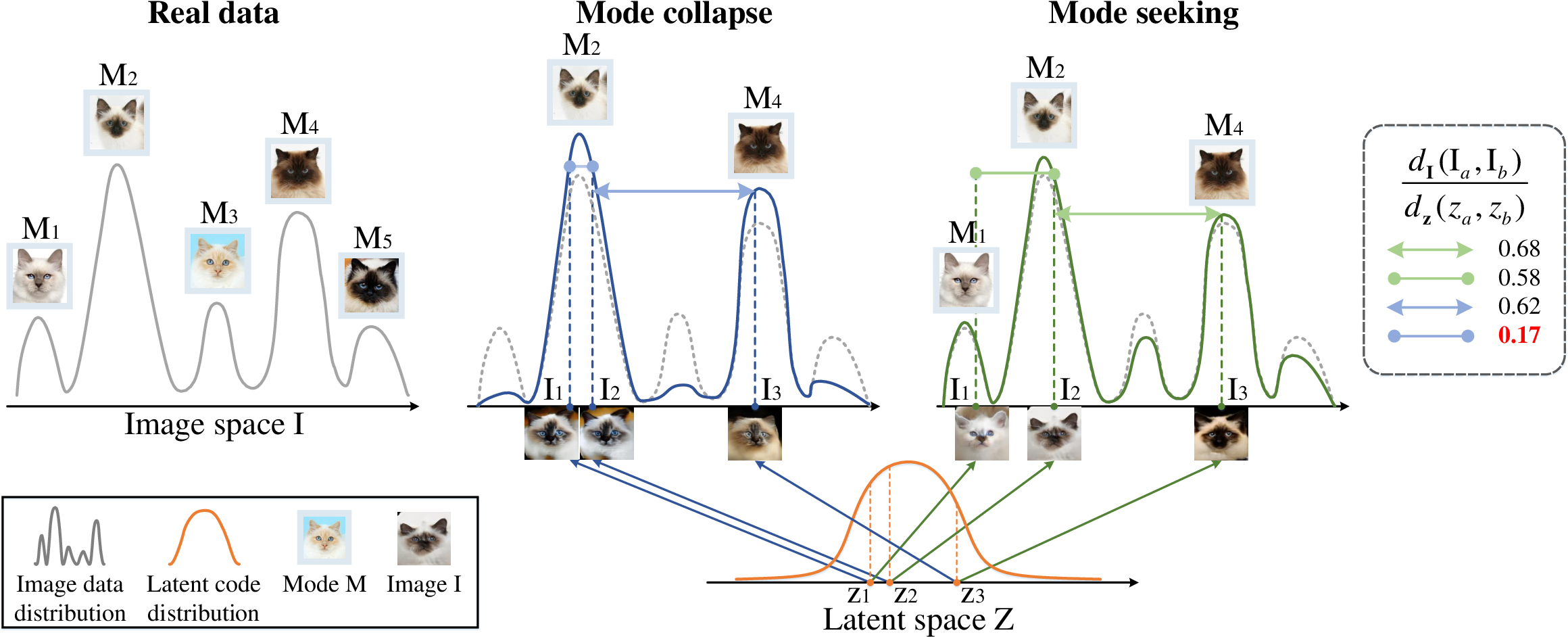
Figure 1: Illustration of motivation. Real data distribution contains numerous modes. However, when mode collapse occurs, generators only produce samples from a few modes.
MSGANs operate on a principle that encourages inter-image diversity during the generation process, thereby facilitating generators to navigate a wider swath of the image distribution landscape. This strategy can be seamlessly integrated with diverse conditional GAN tasks ranging from categorical generation to more complex image-to-image translation and text-to-image synthesis tasks.
Evaluation and Experimental Results
The effectiveness and flexibility of MSGANs have been substantiated across three conditional image synthesis tasks: categorical generation, image-to-image translation, and text-to-image synthesis. In categorical generation with datasets such as CIFAR-10, MSGANs consistently mitigate mode collapse compared to baseline models, notably improving diversity as measured by metrics such as LPIPS.
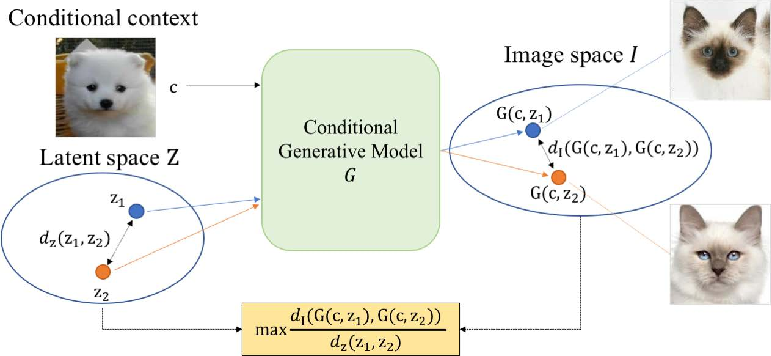
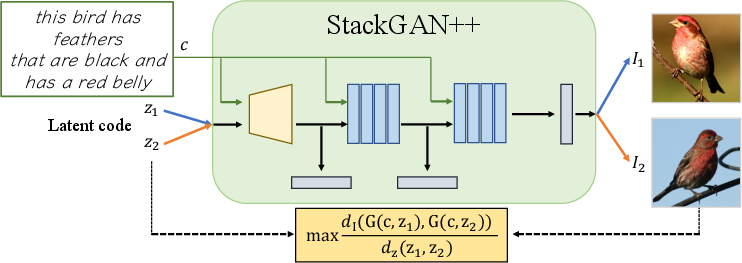
Figure 2: Proposed regularization. (a) We propose a regularization term that maximizes the ratio of the distance between generated images with respect to the distance between their corresponding input latent codes.
The proposed regularization has demonstrated significant efficacy in image-to-image translation tasks. For instance, when applied to Pix2Pix and DRIT frameworks on datasets like facades, maps, and cat-to-dog translations, MSGANs have ensured superior diversity while maintaining comparable visual quality. Similarly, in text-to-image synthesis tasks with the CUB-200-2011 dataset, MSGANs have shown to enhance diversity by introducing variations in latent codes.
Implications and Future Directions
From a theoretical standpoint, MSGANs advance the understanding of the mode collapse problem and propose practical solutions applicable across a spectrum of generative tasks. The significant reduction of mode collapse without additional computational complexity or architectural changes is a notable contribution.
Practically, the ability to generate diverse outputs can expand the use-case scenarios of cGANs, from artistic applications to practical deployments in fields like medical imaging, where diversity of training data is crucial. Looking ahead, future research could explore the integration of mode seeking regularization with other variational and adversarial frameworks to further exacerbate the diversity of generative models.
Conclusion
The introduction of Mode Seeking GANs (MSGANs) marks a significant stride in addressing the intrinsic challenge of mode collapse in cGANs. By employing a straightforward yet effective regularization term, MSGANs facilitate a broader exploration of data modes, ensuring both diversity and quality in generated images. As demonstrated across multiple conditional generation tasks, MSGANs hold promise for widespread adoption in the optimization of image synthesis processes.