- The paper presents DSFD, a dual shot face detection framework that enhances feature representation using a Feature Enhance Module.
- It employs Progressive Anchor Loss to optimize small face detection and uses Improved Anchor Matching to boost detection of occluded faces.
- Empirical results on WIDER FACE and FDDB show high AP scores, indicating significant advancements in real-world face detection performance.
Dual Shot Face Detector: An Expert Review
Introduction to DSFD
The "DSFD: Dual Shot Face Detector" introduces a robust framework for face detection, addressing challenges in feature learning, loss design, and anchor matching. The Dual Shot Face Detector (DSFD) leverages a unique two-stage architecture that significantly enhances the ability of neural networks to detect faces with high variability in real-world scenarios. By employing a Feature Enhance Module (FEM), Progressive Anchor Loss (PAL), and Improved Anchor Matching (IAM), DSFD showcases substantial improvements over traditional face detection methods.
Core Components of DSFD
Feature Enhance Module (FEM)
FEM is designed to produce more discriminative and robust features by extending the capabilities of a Single Shot Detector (SSD) to incorporate dual-shot detection. The module effectively captures complex semantic information through the interaction of feature map cells, enhancing the network's performance without altering its computational efficiency.
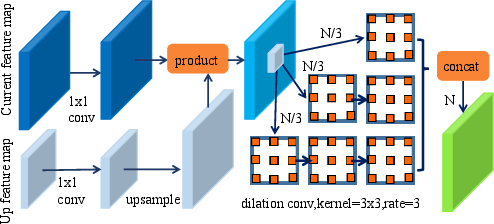
Figure 1: Illustration on Feature Enhance Module, in which the current feature map cell interacts with neighbors in current and up feature maps.
Progressive Anchor Loss (PAL)
The PAL mechanism involves computing auxiliary supervision loss with two distinct sets of anchors. This allows the network to adjust dynamically and optimize the detection of smaller faces using a progressive strategy. This dual-stage approach provides a nuanced method for improving classification accuracy through progressively staged learning objectives, tailored for various scales of anchor sizes.
Improved Anchor Matching (IAM)
In DSFD, the IAM strategy integrates an advanced anchor assignment methodology which enhances the positive anchor match rate for small and occluded faces. By enabling better initialization for the regression network, IAM leads to improvements in detection accuracy. This method effectively increases the recall of challenging faces through enhanced anchor matching fidelity.
Empirical Evaluation
The DSFD model is empirically validated against several leading facial detection benchmarks, notably WIDER FACE and FDDB. The empirical results highlight DSFD's dominance in precision metrics across various difficulty levels.
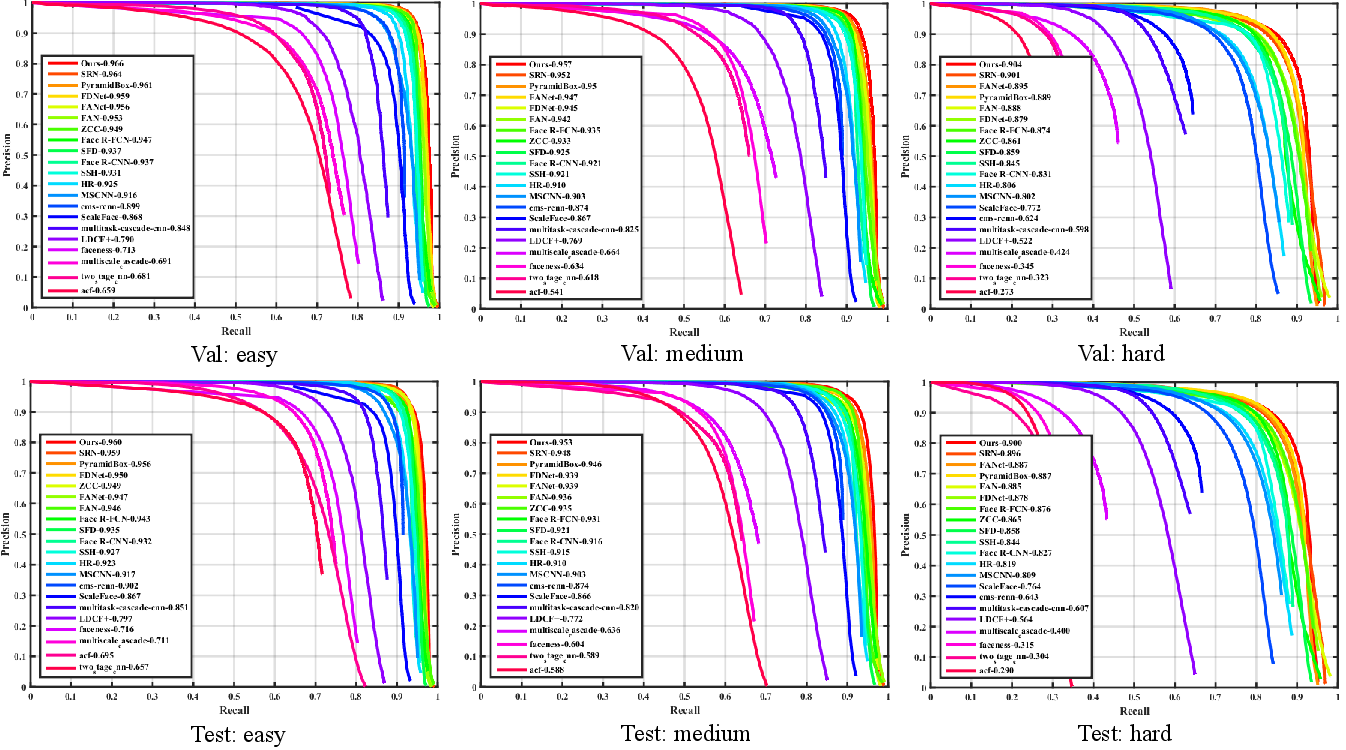
Figure 2: Precision-recall curves on WIDER FACE validation and testing subset.
- WIDER FACE Dataset: DSFD achieved AP scores of 96.6% (Easy), 95.7% (Medium), and 90.4% (Hard) on the validation set.
- FDDB Dataset: Demonstrated cutting-edge accuracy, achieving 99.1% and 86.2% precision in respective tests.
Implications and Future Prospects
DSFD's architectural innovations push the boundaries of robust face detection, offering a framework that adapts to dynamic scales and occlusions. The dual shot strategy combined with feature enhancement modules positions DSFD as a competitive tool in real-time face detection applications, where variance in illumination, pose, and size is prevalent. Future research could explore the integration of DSFD with real-time systems or other domains requiring precise object localization such as autonomous navigation.

Figure 3: Illustration of our DSFD's robustness to various large variations on scale, pose, occlusion, blurry, makeup, illumination, modality, and reflection.
Conclusion
DSFD establishes a prominent methodological advancement in face detection, underpinned by its innovative use of feature enhancement and anchor strategy. The documented improvements in detection accuracy and computational efficiency underscore its significance and broad applicability within computer vision fields. The culmination of techniques within DSFD offers new avenues for enhancing deep learning-based object detection frameworks, with implications that extend beyond facial recognition alone.

