- The paper introduces BlazeIt, which optimizes aggregation and limit queries in neural network-based video analytics using the declarative FrameQL language.
- It employs control variates with specialized neural networks to provide approximate answers with formal error guarantees, reducing costly computations.
- The system achieves up to 83× speed-ups over state-of-the-art methods, demonstrating significant scalability for large-scale video analytics.
Evaluative Essay on "BlazeIt: Optimizing Declarative Aggregation and Limit Queries for Neural Network-Based Video Analytics"
Introduction and Background
The paper "BlazeIt: Optimizing Declarative Aggregation and Limit Queries for Neural Network-Based Video Analytics" (1805.01046) addresses an essential challenge in the field of large-scale video analytics. With the proliferation of video data due to the widespread deployment of cameras, there is an increasing demand for efficient systems to process and analyze video content. This task is severely handicapped by the computational expense associated with deep neural networks (DNNs), particularly for tasks like object detection. BlazeIt intends to ameliorate this challenge by introducing an advanced system that exploits a declarative query language tailored for video analytics, enabling optimizations specifically for two critical query classes: aggregation and limit queries.
BlazeIt System and FrameQL
BlazeIt is a video analytics system that introduces FrameQL, a declarative extension of SQL that supports video-specific functionalities and optimizations. FrameQL enables users to query spatiotemporal information and object data within videos without engaging in programming typically required for low-level DNN operations. The paper presents two novel query optimization techniques integral to the BlazeIt system: control variates for aggregation queries and a specialized search algorithm for limit queries.
Control Variates in Aggregation Queries
One of BlazeIt's salient contributions is the application of control variates through specialized NNs as a variance reduction technique in aggregation queries. This approach allows BlazeIt to deliver approximate answers with formal error guarantees. Control variates effectively utilize inexpensive estimations from lightweight specialized neural networks to minimize the number of computationally expensive object detection operations required to meet accuracy bounds for aggregate queries.
Optimizing Limit Queries
For limit queries, which search for a predefined number of events (like detecting a specific object class), BlazeIt introduces a sophisticated search mechanism that leverages specialized neural networks to prioritize which frames to evaluate, considerably reducing the overall computational cost. This optimization is particularly advantageous for queries concerning rare events, where traditional sampling methods would be inefficient.
The empirical evaluation underscores BlazeIt's performance improvements over existing methods. The system achieves up to 83× speed-ups compared to the state-of-the-art in video processing, demonstrating significant efficiency gains in both aggregation and limit queries.
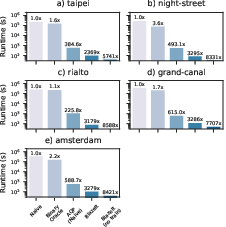
Figure 1: End-to-end runtime of aggregate queries where BlazeIt rewrote the query with a specialized network, measured in seconds (log scale). BlazeIt outperforms all baselines.
Implications and Future Directions
BlazeIt's advancements in video query optimization herald significant implications for the practical deployment of video analytics at scale. The inclusion of control variates and capability to handle declarative queries through FrameQL presents a robust framework for integrating video data analytics with traditional data processing systems. Future work could extend BlazeIt's adaptability to real-time streaming analytics and explore further reductions in model drift effects, enhancing BlazeIt's applicability in dynamic scenarios. Moreover, incorporating more complex query types like joins and global identifiers could broaden BlazeIt's utility in multi-camera environments.
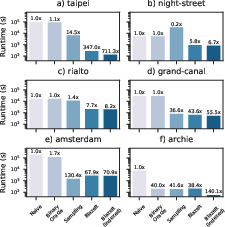
Figure 2: End-to-end runtime of baselines and BlazeIt on limit queries without filtering portions of frames. The y-axis is log-scaled. BlazeIt outperforms the baselines except for sampling on amsterdam.
Conclusion
In conclusion, BlazeIt marks a significant advancement in neural network-based video analytics by providing a comprehensive solution to the computational challenges posed by large-scale video query processing. Through the innovative use of declarative querying and system optimization, BlazeIt establishes a new benchmark for efficient and scalable video data analytics systems. As video data continues to grow, BlazeIt's methodologies are expected to fundamentally shift how we approach large-scale video analytics, paving the way for more agile and cost-effective solutions.