- The paper presents the WinoBias benchmark that exposes a 21.1 F1 score gap between pro-stereotypical and anti-stereotypical roles.
- It employs data augmentation through gender swapping and debiased word embeddings to mitigate systemic bias in NLP models.
- The debiasing strategies maintain competitive performance on OntoNotes 5.0 while promoting ethical, unbiased AI practices.
Gender Bias in Coreference Resolution: Evaluation and Debiasing Methods
Introduction
The paper "Gender Bias in Coreference Resolution: Evaluation and Debiasing Methods" (1804.06876) addresses the critical issue of gender bias in NLP systems, specifically within the domain of coreference resolution. Coreference resolution aims to determine which words in a sentence refer to the same entity. However, existing methods often inadvertently perpetuate societal stereotypes present in their training data. This paper introduces the WinoBias benchmark, a novel corpus designed to expose gender bias in coreference resolution systems by utilizing sentences structured in a Winograd-schema style that require linking gendered pronouns to occupational labels.
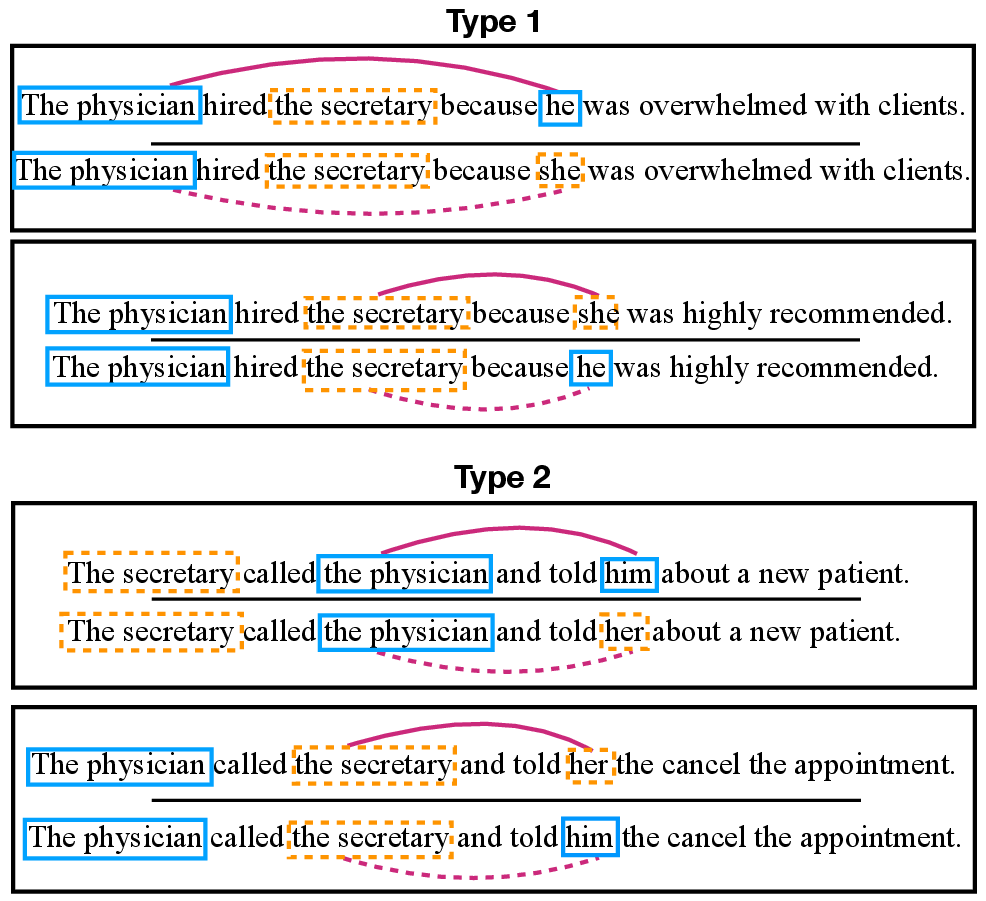
Figure 1: Pairs of gender-balanced co-reference tests in the WinoBias dataset showing pro-stereotypical and anti-stereotypical scenarios.
Evaluating Gender Bias in Coreference Systems
The core of this research is the WinoBias dataset, which is meticulously crafted to reveal the predispositions of coreference systems towards gender-based stereotypes. The dataset comprises sentences with entities denoted by gendered pronouns and their associated stereotypical or anti-stereotypical occupations. The study evaluates three coreference systems: Stanford Deterministic Coreference System, Berkeley Coreference Resolution System, and UW End-to-end Neural Coreference Resolution System. These systems demonstrate a pronounced bias, showing an average discrepancy of 21.1 in F1 score between pro-stereotypical and anti-stereotypical roles.
Mitigation Strategies for Gender Bias
To combat the entrenched bias in coreference systems, the authors propose a comprehensive debiasing strategy that includes a combination of data augmentation and embedding debiasing techniques. By augmenting the training corpus with a gender-swapped dataset and employing debiased word embeddings, the authors demonstrate the capability to mitigate gender bias in evaluation scenarios. This approach not only equalizes the performance across stereotypical conditions but does so without degrading the system's overall performance on standard coreference benchmarks such as OntoNotes 5.0.
Practical and Theoretical Implications
The successful reduction of gender bias without performance penalties has several implications. Practically, it ensures that NLP systems offer fair and unbiased performance across diverse user demographics. Theoretically, it poses a significant advancement in understanding the impact of societal data biases on machine learning models and paves the way for more ethical AI system developments. Future research can expand on these methods, exploring further debiasing opportunities across other NLP tasks and datasets.
Conclusion
The research establishes the severe prevalence of gender bias within mainstream coreference resolution systems and offers robust methodologies for mitigating this bias. Through the development of the WinoBias benchmark and subsequent debiasing techniques, the paper contributes critically to the ongoing discourse surrounding ethical AI. The findings underscore the necessity for continued scrutiny and refinement of NLP systems to ensure equitable treatment across all demographic parameters.